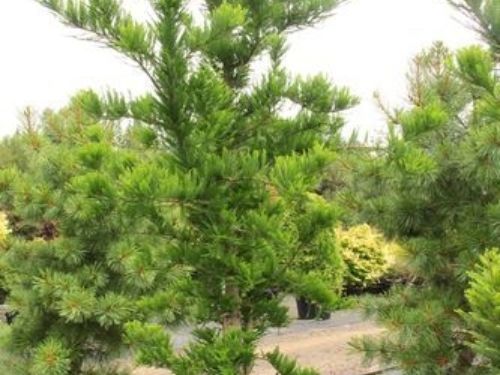
|
|
Posted By administration,
Thursday, June 8, 2023
|
By Frank Goodhart
September 18, 2020
Bald Cypress - a Great Tree for the Home Landscape

Bald cypress (Taxodicum distichum) grove. Photo by Jiaqi Zhang
Bald Cypress for the landscape
At last, bald cypress (Taxodium distichum) is getting some well-deserved attention. No one is exhibiting these plants on floats in home town parades, but the species and various cultivars are finally appearing in leading edge nurseries. Keen gardeners and nursery professionals are wondering why bald cypress has not been grown more often. When bald cypress is mentioned, most people, even those who know conifers, envision a plant in an arboretum or botanical garden, or in any case very near water, as in the photo above. The next thing that is usually noted are the knees, those appendages to the roots that rise above the water level when planted next to, or in, ponds, rivers or swamps. Bald cypress seems to have the status of a novelty tree. Indeed, bald cypress and its cultivars are very underutilized in the landscape and unappreciated considering their endurance, longevity and general landscape value.
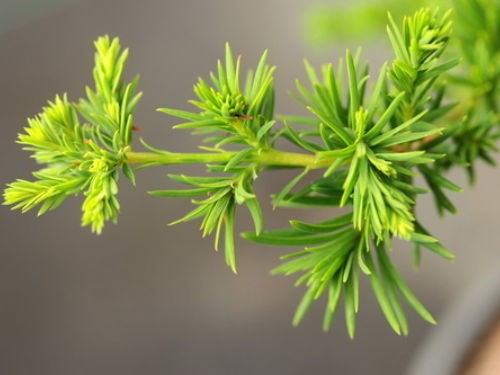
Bald cypress foliage is feathery and delicate. Photo courtesy of Conifer Kingdom
Different kinds of Taxodium
The bald cypress is the best known of the three species of Taxodium, and the one which has been most often planted. Pond cypress (Taxodium ascendens) is a junior version of bald cypress and is also native to the USA, whereas the Montezuma cypress (Taxodium distichum var. mexicanum) is native to Mexico. There are a number of other common and local names for bald cypress, including common bald cypress, bald-cypress, cypress, southern cypress, swamp cypress, red-cypress, yellow-cypress, white-cypress and gulf cypress.
My first experience seeing Taxodium was in a swamp in a bird sanctuary in southern Florida. At that location the water was at various depths; bald cypress was growing in deeper water, whereas pond cypress was growing in shallow water and appeared to be stunted in slightly deeper water. I have since learned that low, but not swampy areas may contain a mix of taxa. Both, in their native habitats, grow in areas where there is high water availability; that is, in coastal regions with a good supply of fresh water such as deltas, swamps and lowlands where there is a seasonal swelling and ebbing of water, and also along streams, ponds, and rivers. Ironically, bald cypress is much more tolerant of water than the pond cypress, which grows on higher ground.
Native Habitat for Bald Cypress
The native habitat includes the Atlantic coastal plain from Delaware to Florida, and then westward in coastal states bordering the Gulf of Mexico and Texas. It extends from the Gulf States northward into southeast Oklahoma and then via the Mississippi River valley to the southern parts of Missouri, Illinois, Indiana, Kentucky and Tennessee. In the non-coastal states, its habitat is very limited. It almost always appears in elevation not exceeding 99 feet (30 m), except on the Edwards Plateau in eastern Texas where it grows at an elevation of 989-1748 ft (300-530m). The US Forest Service has a good map of the native range of Taxodium distichum.
T. d. 'Peve Minaret'. Photo courtesy of Conifer Kingdom
Growing Bald Cypress
Many bald cypress in arboreta and botanical gardens are planted next to water to facilitate knee development. But bald cypress need not grow in or near water. It grows well in average soil conditions and can tolerate slightly alkaline (not extremely alkaline) and acidic soils in a sunny location. Bald cypress hardiness zones are listed as 4-9, 5-10, and also 4-11. There are reports of bald cypress growing in Minnesota and New York in zone 5 or colder. It can with stand substantial wind, ice, and snow with little or no damage.
For example, an allee of bald cypress was planted at Longwood Gardens before 1955. These trees are very large and have withstood the test of time, soaking up a number of Mother Nature’s worst assaults, including the extremely heavy snowfalls in January and February 2010. It is speculated that bald cypress withstands weather extremes because of its extensive root system. The leafless winter branches do not collect or support a great deal of snow.
Bald cypress is not seen often in the northern landscape, perhaps due to the popularity of a similar looking tree, the dawn redwood (Metasequoia glyptostroboides). There are many reasons to grow bald cypress: in the north, the leaves remain on the tree almost four weeks longer than other deciduous trees and the orange fall color is eye-catching. The leaf litter, which is actually a mix of the leaves and some branch tips, falls directly under the tree and provides colorful mulch, eliminating the need for leaf removal. The new seed cones are colored a slight pinkish-green and are symmetric, and the tree itself provides a fantastically beautiful silhouette in the winter. At places where the bark is fragmenting, there are pretty patches of orange-brown color showing through.
Leaves drop seasonally at different times depending on the latitude. In the south it may be considered to be ‘tardily deciduous’, while in the north it is fully deciduous. Leaf color varies through the season, starting off light green and then changing to darker green, before reaching the orange to golden-yellow coloration in late fall and winter.
The branches on younger trees may be slightly ascending and become more horizontal upon aging. The bark is thin and appears as variably sized sections that are separated from each other. On older trees, it is charcoal to ashy gray and the fissures be tween the sections are an orange tinted tan, an attractive feature. Large patches of orange-peeling bark appear on young trees and trees exposed to high amounts of water.
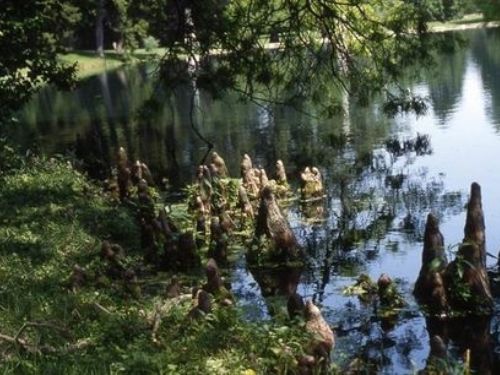
Knees on a group of wild Taxodium Distichum (bald cypress)
Bald Cypress Knees
Knee development by bald cypress is a novel feature and one that does not occur in any other conifer species except for Glyptostrobus pensilis and other Taxodium species. Technically known as pneumatophores, knees are root appendages that develop on bald cypress when the tree is planted in or near water. Knees are irregular conical structures that protrude around the tree above the water line or ground level. Small knees may be more like squat cones, while older knees may be strongly conical and irregular. Knees may extend to quite a distance from the tree and their size is dependent more or less on the tree’s exposure to water and the tree’s age. Hence, trees that are basically submerged will produce more and larger knees; but as a landscape tree with water available only from normal rainfall, no knees develop. Younger trees in a moist or wet area may exhibit knees of various heights from a few inches to many feet. There are literature reports of knees as high as six and a half feet (2m). Knees do not have the capability to sprout, whereas sprouting can occur from the stumps of cut trees.
The function of knees has never been adequately explained, but there are several theories. One is that they provide extra support and help to prevent extensive damage from high winds that may be experienced in the tree’s native habitat. Another is that the high starch content of the knees provides a back-up food source for trees whose roots are exposed to water much of the time.
Bald cypress, when exposed to water for an extensive period of time, form broad conical buttresses (root flares). The size of the buttress is directly related to both the time that it is exposed to water and the depth of the water. In a swamp, or an area that is periodically flooded, the flared base of the tree is quite evident. Those that are planted close to or next to water will show a significant root flare at the base of the buttress similar to Metasequoia in both form and color. However, landscape trees planted in an area without extra moisture exhibit buttresses similar to those of many other trees.
As one might surmise, the biomass produced by trees growing in a wet or moist condition versus those on higher land receiving water only via normal rain fall differ significantly. Landscape trees will have more limbs, and hence more leaves, whereas those exposed to water will grow fewer limbs and leaves. Bald cypress growing in wet conditions can become massive in time, but the growth rate of trees growing in a normal landscape will be greater.
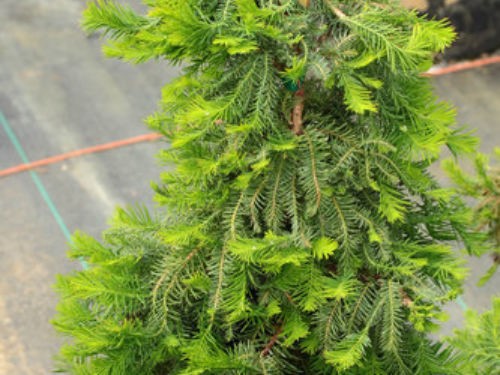
T. d. 'Codys Feathers'. Photo courtesy of Conifer Kingdom
Bald Cypress Cultivars
Until recently, bald cypress did not have a great number of cultivars, but unique new ones have been identified and propagated in recent years. The following is a list of most cultivars currently in the trade. A longer list prepared by Laurence C. Hatch can be found at www.cultivar.org, and it includes many names of historical interest.
Note that different cultivars offer choices in height-width ratio (narrow to broad), growth rate, and weeping and upright forms. Some were found as seedlings and others as witch’s brooms.
- ‘Monarch of Illinois’, a wide-spreading and leaderless tree which would be effective in a large landscape. Another similar cultivar having a similar height and breadth is ‘Nelson’, which does have a central leader, coupled with a horizontal branching habit. An extra attraction is that it cones heavily every other year.
- Shawnee BraveTM is a chance seedling that was propagated and distributed by Earl Cully. The limbs are branched upward at about 45-50 degrees and it has formerly attained a height of 75 feet (23 m) and a width of 18 feet (6 m). It has never formed cones and propagation is via chip budding onto seedlings grown using a northern seed source to ensure maximum hardiness.
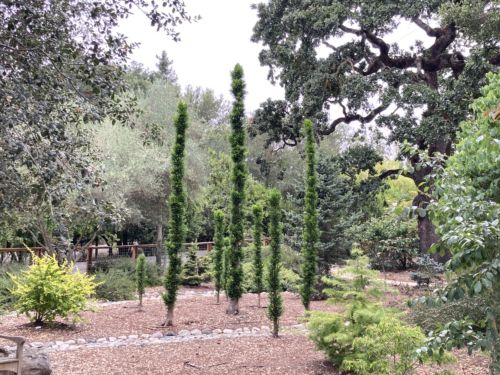
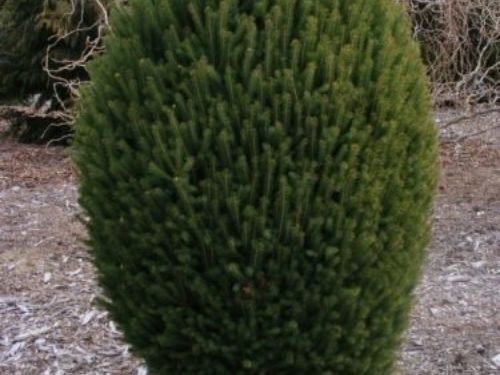
Taxodium distichum 'Peve Minaret' pruned annually. Photo by Sara Malone
Dwarf Bald Cypress Cultivars
Several dwarf cultivars derived from bald cypress have become popular in collectorsgardens in the past few years. These include ‘Cascade Falls’, a weeping form from New Zealand and ‘Peve Minaret’, an upright small tree from the Netherlands.
- ‘Cascade Falls’ bald cypress is now widely distributed in the USA. It can be high grafted or grafted low and trained high to obtain the weeping effect. In either case the multiple branches weep from the crown providing an open feathery habit that is distinctive from the evergreen weeping conifers. It is normally seen in the nursery in a form many times higher than wide and can be kept more narrow and shorter by pruning in winter. The leaves turn the typical orange-brown in late autumn and the weeping branch structure itself is a marvelous winter landscape feature.
The history of ‘Cascade Falls’ is well documented; it is traced back to a noted New Zealand horticulturalist, Graeme Platt, and his wife. They bought some “swamp cypress” from a wholesale nursery in Auckland during 1984-1985. After planting and observing them over a period of time, they noticed that many trees were twisted and deformed. But one tree had a cascading growth pattern that visitors to the garden remarked upon. The Platts allowed it to grow at the edge of a pond for 15 years and then gave some scions to David and Noeline Sampson to graft. After two years of evaluation, the Sampsons recognized the value of the plant, obtained the intellectual rights, and put it into propagation.
- ‘Peve Minaret’ is dwarf conical tree seedling derived from a freely pollinated bald cypress. It is described by Job Vergeldt as follows: “The dark green needles are smaller than those of the species and somewhat variable in length. Especially the tips of the needles are densely congested. An eight year old tree reaches only one meter (3 ft).”
Descriptions of the ultimate size and growth rate of ‘Peve Minaret’ by various nurseries differ somewhat. Currently, the 10 year size is generally listed as eight to 10 feet (2.5-3m) tall with a width about two to four feet (.5-1.2m). Some specimens seem to be rather tall and narrow. As the tree is widely adaptable to different growing conditions, it fills an important niche in landscape design, offering a size and appearance nuance not available with other woody plants.
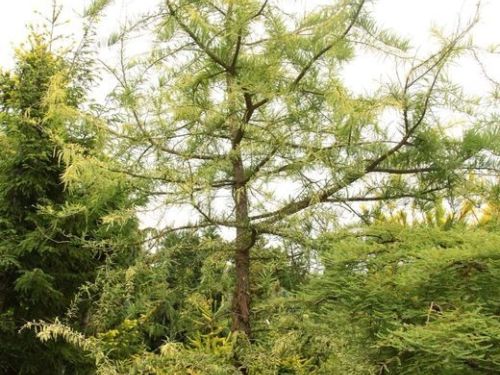
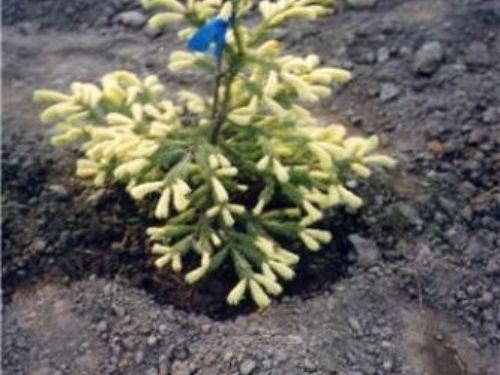
T. d. 'Peve Yellow'. Photo courtesy of Conifer Kingdom
In the photo above, you see a group of 'Peve Minaret' at ACS website editor Sara's Malone's Petaluma, CA ranch. She chose what she describes as a 'wettish' part of her property, but notes that in her Mediterranean climate the trees thrive on just twice-weekly drip irrigation. For novelty value, she prunes the branches annually to between 1-2", thereby creating what she calls a 'forest of green totem-poles.' Pruning Taxodium is easy; they are very forgiving trees. This treatment would allow even the smallest garden to include a bald cypress!
Job Vergeldt describes ‘Peve Yellow’ as a “yellow-needled cultivar originating as a seedling from the same group as ‘Peve Minaret’. It is an upright deciduous conifer with golden-yellow foliage in spring. During the summer, the color of the foliage is somewhat paler and finally it is light yellow to pale yellowish-green. ‘Peve Yellow’ is a pyramidal, fairly densely branched tree growing only half as strong as the species.”
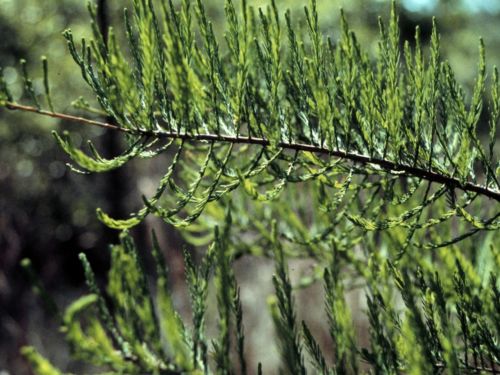
Pond Cypress (Taxodium ascendens) foliage. Photo courtesy of Wikipedia
Pond Cypress
The popularity of pond cypress (Taxodium ascendens) has also grown in recent years, partly because it is smaller, narrower, and more conical than the bald cypress. One could say it is a junior version in every respect as there are size differences in ultimate height and width as well as the sizes of the leaves and cones. Also, its branch pattern is much more vertical. While both the pond cypress and bald cypress grow in similar locations and places, there are notable differences between them. Pond cypress grows in its natural habitat in wet areas near sources of water, but not in the deeper or sustained water levels where bald cypress grows. The two trees sometimes grow in the same area adjacent to one another, but the pond cypress will be on the higher ground.
This is quite evident in Florida where cypress domes or hummocks are surrounded by swamp. The fact that it grows along ponds, streams, and rivers indicates also that it does not receive the same nutrients from wet ground that bald cypress might. While it will form knees, they are smaller and less frequent than those of bald cypress.
The leaves of pond cypress are shorter and thinner than bald cypress. The ranking of the leaves is also different in that those of pond cypress are upright. The cones are smaller than those of bald cypress, but the off-round shape is similar. The bark is deeply furrowed and brown. In time, pond cypress can reach a height of 60-80 feet 18.2-13.6m) and a width of 15-20 feet (4.5-6.Im). The National Register of Big Trees lists the largest tree as one in Bowie, Maryland: it is 100 feet (30.3m) high, has a spread of 74 feet (22.4m) and a trunk circumference of 150 inches(3.8m).
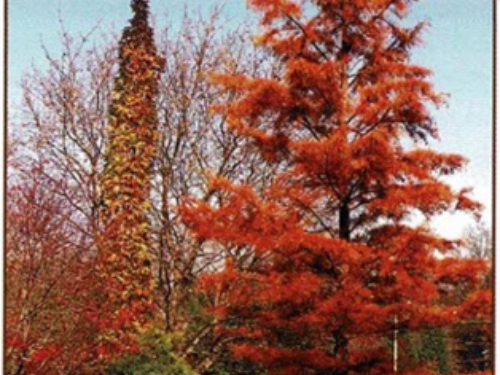
Pond cypress also has gorgeous fall color
The natural distribution of pond cypress is from Virginia to Florida along the Atlantic seaboard and westward into the Gulf of Mexico states of Alabama, Mississippi and Louisiana. It does not appear in the upper parts of the Mississippi River delta and estuaries, as does the bald cypress. The hardiness zone is often listed as 5-9 with reference to extension somewhat outside these zones both on the warmer and colder sides. Hence, it is less hardy than bald cypress.
Pond cypress is an extremely under-utilized conifer. In the landscape, it has a magnetic drawing power and it attracts one’s immediate attention. It seems that it is just the right size for the home landscape, due to its columnar habit and small stature. It is straight and has an upward branching pattern. The leaves are feathery; the fall color is a wonderful version of a rusty orange, and the winter aspect seems just right, especially on a bleak, cloudy day. This, together with the fact that it is easy to grow and care for, makes it truly an outstanding deciduous tree specimen in the landscape. There are other appropriate uses for pond cypress, as well. It can be used in slightly wet sites in random order or even as a screen together with some other shrubs that tolerate high moisture levels.
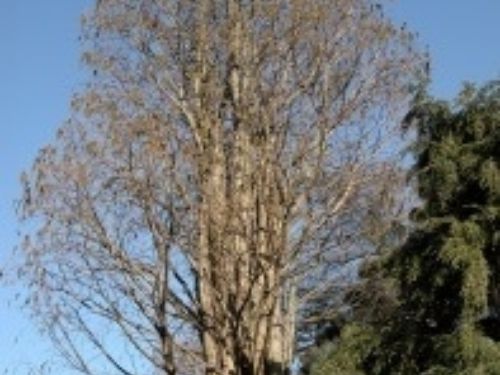
Taxodium ascendens 'Morris'
Pond Cypress Cultivars
There are two columnar and slower growing cultivars derived from pond cypress that can fill an important niche in the landscape since they are more moderate in size yet have the same favorable cultural characteristics of the species.
- ‘Morris’ (DebonairTM). Quoting Tony Aiello of the Morris Arboretum on the history of the pond cypress cultivar ‘Morris’: “The original plant is from the (John and Lydia) Morris Estate. It was planted hardy.” ‘Morris’ is an extremely narrow columnar tree; the branches of the still existing original tree at Morris Arboretum (pictured above) sweep strongly upward, in the area of 70-80 degrees.
- ‘Nutans’ Another commonly available pond cypress is Taxodium ascendens ‘Nutans’. The foliage is delicate and strap-like and the tree is narrow and slow growing. The leaves have the same rusty orange color in the fall as the species. This cultivar, as well as ‘Morris’, has wonderfully tall narrow silhouettes in winter.
Fortunately, the availability of these special forms of Taxodium is increasing and certainly more will be seen in the landscape in the future. If you haven’t discovered how a Taxodium might enhance your landscape, now is a great time to explore!
This post has not been tagged.
Permalink
|
|
|
Posted By Admin,
Wednesday, June 7, 2023
|
How to Create your Own Conifer Varieties
By Robert Fincham
November 8, 2019
Tap into the technique of controlled pollination and make your own conifer cultivar.

I am working on my second conifer book and thought it might be a good idea to share some of the information with ACS members. This article will be included in one of the chapters. The title of this article is a bit misleading since hybrids tend to be interspecific, such as Cupressus nootkatensis and Cupressus macrocarpa being cross pollinated to produce Cupressus x leylandii.
I am going to discuss crossing two different cultivars within one species to create new cultivars. Strictly speaking, not true hybridization. A typical conifer will possess both male and female reproductive organs. The male organs (sporangiophyll) will produce the male sex cells (sperm cells) contained within capsules called pollen grains. The female organs, commonly called cones, sometimes mistakenly referred to as flowers, will produce female sex cells (eggs) which, when fertilized, will develop into seed-containing cones.
Controlled Crosspollination in Conifers
The female organs develop high on the plant and the male organs develop lower on the plant so that self-fertilization is less likely to occur. Since conifers are not insect-pollinated and depend upon the wind for transferring the pollen from the male to female parts, there is little likelihood of the pollen just falling onto the female cones of the same tree.
To perform a controlled crosspollination of two conifers, the pollen from one conifer must be transferred to the other by some mechanical means, usually a simple brush. Greg Williams of Vermont has grown a number of interesting conifer seedlings through a process of cross-pollination within a species. Pinus strobus ‘Horsham’ is a dwarf cultivar which produces viable seeds.
By planting a ‘Horsham’ beneath a cultivar of Pinus strobus, it is possible to produce seedlings with characteristics of both plants, since the pollen will fall from the larger plant onto the smaller one. Williams’ selections of dwarf Pinus strobus with twisted needles and branches were developed in this way by crossing Pinus strobus ‘Torulosa’ with Pinus strobus ‘Horsham’ to produce ‘Mini Twists’ and ‘Tiny Kurls’.
Pollinating Picea abies
I was visiting with Karel Maly in the Czech Republic in 2000 when he showed me assorted batches of seedlings he was growing from Abies koreana. I asked him how he did his cross-pollination, and it turned out to be a very simple process. In the spring, as soon as the pollen started to fall from the male strobili of Abies koreana, he would collect pollen in a paper bag and then brush some of that pollen onto the appropriate female strobili.
He did this every day for at least a week. By smothering each female strobilus with such copious amounts of pollen, he did not need to worry about wind-transported pollen. If he were attempting scientifically pure crosses, he would have to cover the cone.
During the spring of 2001, I noticed that one of my Picea abies ‘Gold Drift’ ‘Gold Drift’ garden plants had a male strobilus about to produce pollen. I thought I might as well put the information that I gleaned from Maly to good use. I collected the pollen in a plastic bag as soon as it was ripe. Then, using a fine brush, I applied some of the pollen to several cones on an older Picea abies ‘Acrocona’ growing in another area of our gardens.
I did not bag the cones on the ‘Acrocona’, but I did do repeated applications of the pollen over a period of about one week. I knew the cones were ready for pollinating because the scales were spread open, and the ‘Acrocona’ was producing pollen.
Seed Collection and Selection
I collected the seeds in the fall of 2001 and stratified them for three months in a refrigerator. I germinated the seeds in the spring of 2002 in a seed flat. I potted 60 of the lightest colored seedlings the following spring with a repotting in 2005. Then, I selected the golden seedlings for planting out into the ground in 2006. There were 28 golden seedlings finally selected out of about 200 germinated seedlings.
I had a specific goal in mind. I wanted to develop a golden weeping spruce which would produce cones at the ends of its branches. If I were successful, I expected the cones would be red when they first appeared, and that the contrast with the golden foliage would be striking.
As part of the selection process, I wanted to compare grafted plants with the original seedlings. At the first opportunity, I grafted scions from each seedling. The plants produced by this grafting were set aside for later evaluation. These grafts were three years old in 2009; so, I planted one of each close to its parent plant. They all appeared to perform in the same manner as the original seedlings. That was an important observation.
Seedling Comparison
In October 2010, I made six selections from the seedlings and gave them permanent names. The other twenty-two original seedlings were given provisional names. The selection process proved to be difficult since all of the seedlings exhibited a variety of growth habits as well as a range of shades of yellow through gold. Five of the plants exhibited very bright yellow foliage and burned in the sun.
These I moved to partially shaded locations, which stopped the burning and slightly reduced the brightness. These all have ‘Lemon’ as part of their names. The others are performing nicely in the full sun. They flush yellow, then they become lime green before turning yellow on the sunlit surfaces; they color up similarly to ‘Gold Drift’. One original selection only shows some color in the winter and is only lime green in the spring. It does not even have a provisional name. They all burn to some extent until established. Some watering during dry spells helps to prevent burning on smaller plants.
The foliage of the seedlings also differs from the parents in two ways. First, the needles are shorter and much thinner than with either ‘Acrocona’ or ‘Gold Drift’. Second, some of the new growth will occasionally exhibit foliage with exceptionally pale shades of yellow. I expected cone production to begin any time after about five years.
Seedlings of ‘Acrocona’ started producing cones at about that age. Sure enough, some red cone scales started to appear on a few of the seedlings about when expected. The cone production will never be quite as prolific as ‘Acrocona’ since the chlorophyll content is less, and the energy available for cone production is more limited. None of the “Lemon” series have shown any signs of coning as of 2015.
Seedling Growth
One of the more surprising developments is the wide range of growth rates. Neither of the parent plants is dwarf. Even ‘Gold Drift’ with its golden foliage has a rapid rate of growth. The source of the dwarfing gene is unknown at this time since it is not apparent in either of the parent plants. In addition, the seedlings have shown some interesting intermittent characteristics.
Cone scales, which do not develop fully into cones, are located at the ends of some of the branches. Numerous buds will often form within and below these scales. When the buds push in the spring, tufts of congested branchlets result. On occasion, large numbers of buds form at the ends of the new year’s growth.
The following spring, these buds erupt to create masses of short branchlets all over the plant. I originally named the following six plants. The rest will be featured in my upcoming conifer book.

The conifer, Lemon Drop Norway Spruce (Picea abies ‘Lemon Drop’)
Picea abies ‘Lemon Drop’
Dense, dwarf and globose, it does show a tendency to burn since it has small, thin needles and bright yellow foliage. It grows 1–2 inches per year and will possibly never bear cones due to its small size and bright yellow foliage. However, as it gets larger, it may be able to produce enough extra food to bear cones. The plant pictured here is growing in indirect light and spends less than one hour in the sun. It is thirteen years old in this picture.

The conifer, Dandylion Norway Spruce (Picea abies ‘Dandylion’)
Picea abies ‘Dandylion’
Broad and pendulous, this selection is the one most like ‘Gold Drift’ in growth habit. It does produce upright shoots, but, so far, they do not continue upward. Its growth habit is spreading with horizontal to slightly pendulous side branches. This seedling first produced cones in the spring of 2010. The foliage is bright yellow in the spring, dulling slightly in the summer and then coming back in the fall. The needles are smaller and thinner than the species. It receives about four hours of direct sun per day and is thirteen years old in the picture.

The conifer, Gold Finch Norway Spruce (Picea abies ‘Gold Finch’)
Picea abies ‘Gold Finch’
Dwarf and spreading with pendulous branches, this selection is brighter yellow and considerably slower growing than ‘Dandylion’. ‘Gold Finch’ has not yet started producing cones due to its dwarfness and yellow foliage. It may produce terminal cones as it develops more size. It is a dwarf ‘Gold Drift’ and may be staked or grown as a ground cover. The original plant is to the right and gets limited direct sunlight during the day. It was thirteen years old when this picture was taken. The plant to the left was nine years old and grafted from the original selection. Notice the brighter color in the sunlight.

The conifer, Chub Norway Spruce (Picea abies ‘Chub’)
Picea abies ‘Chub’
I named this plant ‘Chub’ in honor of Justin “Chub” Harper and have donated the mother plant and all but one graft to the Harper Collection at Hidden Lake Gardens in Michigan. They will control any future availability of this selection. Densely branched and broadly conical, it has been producing cones since 2010. During the spring 2009, it had over 30 buds on terminal shoots, and every one pushed, contributing to the dense branch structure shown in the pictures. Apparently, this plant will be a dense, broadly conical, small tree. I no longer have the original plant growing here; so, this picture is from 2010, and the plant was eight years old.

The conifer, Summer Daze Norway Spruce (Picea abies ‘Summer Daze’)
Picea abies ‘Summer Daze’
This selection has developed a very interesting growth habit as it approaches its thirteenth year of growth. It appears to be developing an upright growth habit, but the side branches are all strongly pendulous. The yellow color with its terminal cones and pendulous side branches makes for a plant with unlimited potential for the landscape. The plant was ten years old in this picture and shows good color. Since then, it has become partially shaded, and the color is not as bright.

The conifer, Honey Pot Norway Spruce ( Picea abies ‘Honey Pot’ )
Picea abies ‘Honey Pot’
A slow-growing plant, Picea abies ‘Honey Pot’ is mounding with nice yellow foliage. The needles are small, and the branching is dense. It is almost globose and is staying quite dwarf. Coning has not occurred yet, but I have expectations that, as the plant ages, the cones will appear. The plant was ten years old when this picture was taken.
Cultivar photographs by Bob Fincham. Thumbnail photograph by Mohammad Emami.
This post has not been tagged.
Permalink
|
|
|
Posted By Administration,
Wednesday, June 7, 2023
|
By Tom Cox
October 3, 2019
Learn about the conifers in the Mexican state of Jalisco.
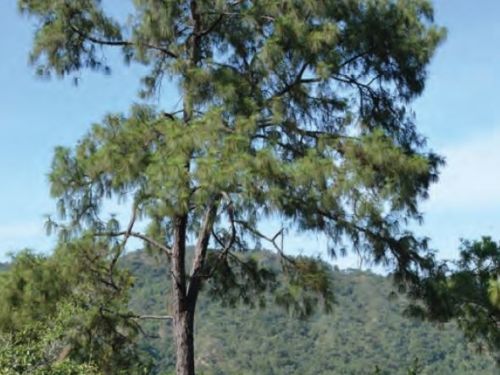
A wide shot of the conifer, Pinus vallartensis (Vallarta pine)
A recent trip to Puerto Vallarta, Mexico, afforded me the honor to spend a day with the leading pine expert in that country, Dr. Jorge Alberto Pérez de la Rosa. As a prelude to the narrative concerning this important meeting, I offer the following background, in order to provide context.
When I first developed an interest in conifers, my assumption was that conifers from Mexico, Central America, and South America were not suitable for the USDA zone 7b climate in north central Georgia, where my home and arboretum are.
My previous focuses had been North America, Central Europe, Asia Minor (Turkey), and Temperate Asia (Far-eastern Russia, Mongolia, Eastern and Inner China, the Korean Peninsula, and Japan). In part and as a result of my extensive travels throughout the world, plus good connections, I have enjoyed access to numerous genera to evaluate.
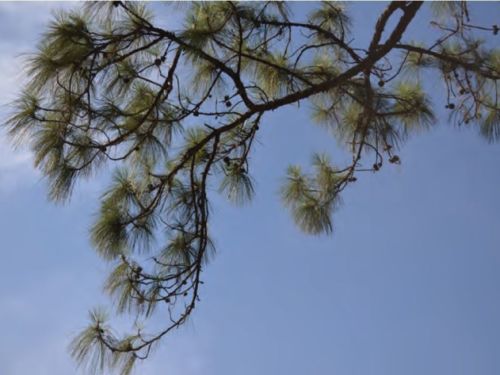
A canopy shot of the conifer, Pinus vallartensis (Vallarta pine)
Growing through my Conifer Journey
After over 25 years of trial and error, I had begun to develop a fair understanding
of the areas from which I could select specimens. As an example, Abies (fir) from the West Coast of the United States are not suitable for our growing conditions in Georgia and the Southeast.
The same is true for a number of conifers that are native to the eastern slopes of the Sierra Nevada range. My specific geographic area is too wet. I have trialed and have lost almost all conifers that are native to Australia, New Zealand,
and Tasmania. The conifers of these countries do not adapt well to my soil, moisture regime, and hot nighttime temperatures.
Approximately 10 years ago, I was introduced to Jeff Bisbee, who lives in Gardnerville, NV. Jeff is an expert on
the conifers of his region and has also collected specimens extensively in Mexico. On one of my trips to visit him, he shared several species for trial. After meeting Jeff, I then met Dr. Jason Smith, who is a plant pathologist at the University of
Florida in Gainesville, FL. Dr. Smith is credited with discovering Fusarium torreya, the fungus responsible for the decline of Torreya taxifolia (Florida torreya),
the most endangered conifer species in North America.
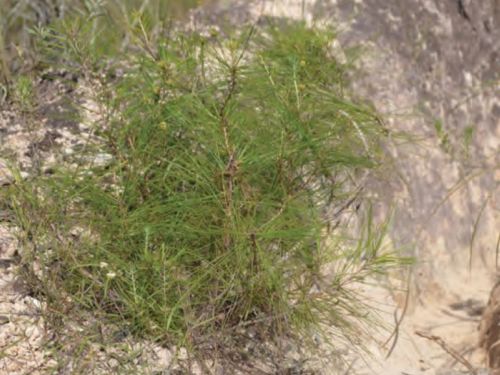
Another shot of the conifer, Pinus vallartensis (Vallarta pine)
Consulting with the Conifer Experts of North America
Dr. Smith also has assembled a significant collection of Mexican
conifers at his research station in Gainesville and was happy to share plants with me for evaluation. In my zone, I can now successfully grow 7 Pinus (pine), 3 Juniperus (juniper),
3 Abies (fir), 1 Pseudotsuga (Douglas-fir), 2 Cupressus (cypress), and 3 Picea (spruce).
All have been in the ground at my arboretum long enough for me to be comfortable with their adaptability.
Whenever I thought of Mexico, I thought of a hot, dry, and flat place; a result, no doubt, of watching too many Clint Eastwood Westerns.
However, I learned several facts about Mexico. Although the highest point in eastern North America is Mt. Mitchell, NC, at 6,683 feet (2,000 meters), there are several mountains in Mexico in the 17,000- to 18,000-feet (5,100- to 5,182-meters) range!
Due to cold tolerance, many conifers will adapt to our north central Georgia zone 7b and elsewhere, even zone
6. The higher elevation species, such as Pinus cembroides (Mexican pinyon pine), are too alpine for our heat. Likewise,
species such as the most beautiful Pinus lumholtzii (Lumholtz’s pine) are too tender.
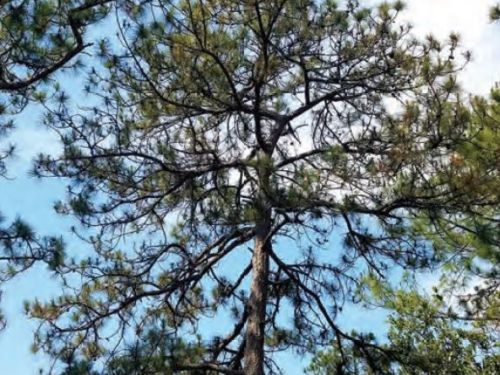
The conifer, Pinus maximinoi (Maximo’s pine) in the mountains of Puerto Vallarta, Mexico
Meeting Dr. Pérez de la Rosa, University of Guadalajara
In early April 2019, my wife, Evelyn, and I found ourselves in
Puerto Vallarta with an open day to do non-touristy things. In advance of our trip, I had reached out to Neil Gerlowski, the Executive Director of Jardín Botánico de Vallarta (Vallarta Botanical Garden). He kindly arranged an email exchange between
me and Dr. Pérez de la Rosa, mentioned above, who had to drive almost 5 hours from his home to meet us.
He is a researcher and professor in the Department of Botany and Zoology at the University of Guadalajara. He is also co-author with
Aljos Farjon and Brian Styles of the book, A Field Guide to the Pines of Mexico and Central Mexico.
Although our bilingual skills were limited, our love of plants and knowledge of botanical nomenclature transcended the language
barriers Dr. Pérez de la Rosa and I had. Neil Gerlowski had also accompanied Dr. Pérez de la Rosa. After a one hour drive out of the city, we were in the mountains, where the lush scenery mirrored the images from books that I had read.
The
countryside was replete with Quercus (oak) and numerous species of Magnoliaceae (magnolia family). In the distant mountains, we would see cloud forest, and I found myself wishing I were able to explore the area on foot.

The cone of Pinus oocarpa (Mexican yellow pine) in Puerto Vallarta, Mexico
The Recently-Discovered Conifer in Puerto Vallarta, Mexico
Dr. Pérez de la Rosa pointed to a remote spot high in the mountains
where he had discovered a recently described species of pine from the western state of Jalisco. Pinus vallartensis (Vallarta pine) occurs near the southern limit of the Sierra Madre Occidental mountain range in northwestern and western Mexico.
It is known from only one location where individual trees grow scattered on a northern exposed hillside with grassland and open forest of pine and oak. Estimates are that its area of distribution extends only a few square kilometers, and
the number of mature specimens is fewer than 2,500 trees.
Dr. Pérez de la Rosa reports that the habitat generally is open grassland, making the area vulnerable to frequent fires, both natural and intentionally set to promote cattle grazing.
Since a part of our mission at the Cox Arboretum and Gardens in Canton, GA, is the conservation of endangered conifer species, I was hoping to obtain seed.
With our median temperature of 78°F (26°C), this pine would not survive in Georgia.
However, the request for seed was not in vain, as Dr. Pérez de la Rosa promised to send me seed from a high elevation population of Pinus lumholtzii (Lumholtz’s pine), which I consider the most unusual of all Mexican pines.
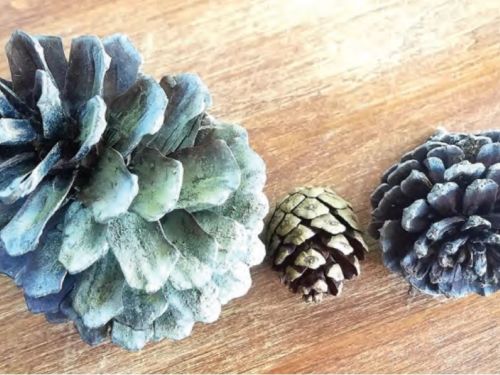
The conifer cones of Pinus miximinoi (Maximo’s pine) from Puerto Vallarta, Mexico
Pine Tree Variety in Puerto Vallarta, Mexico
The other three pines in the area are Pinus oocarpa (Mexican yellow pine), P. jaliscana (Jalisco pine), and the more distantly-related P. maximinoi (Maximo’s
pine). We drove to an area where I was able to photograph and collect cones of P. oocarpa and P. maximinoi. Regrettably, I passed on looking for P. jaliscana, the rarest of the three. I was advised that the area where P. vallartensis could be seen was too rugged for me to attempt.
As a consolation, Dr. Pérez de la Rosa kindly presented me with cones and an article he had written describing the species. It is significant to mention that Mexico contains more species of
pine than any other country and, within the state of Jalisco, where we traveled, there are 20 conifer species.
Like its neighbor to the north, Mexico is ecologically quite diverse. At the driest extremes live Pinus monophylla (single-needled pinyon pine) and some of the related species, which co-exist in semi-desert and desert conditions. In contrast, some pines occur in extremely wet and cool high-altitude forests, often with conifers such as Abies (fir), Pseudotsuga
(Douglas-fir), and Cupressus lusitanica (Mexican cypress).
In my opinion, Mexico is an under-explored area for conifers, as well as home to beautiful broad-leaf taxa.
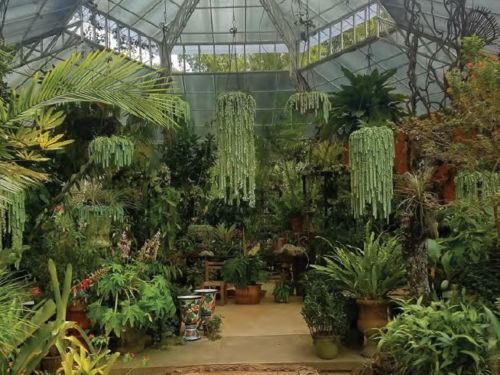
The Vallarta Botanical Garden in Puerto Vallarta, Mexico
Mexico's Vallarta Botanical Garden near Puerto Vallarta
At the conclusion of our field visit, we were driven to Vallarta Botanical
Garden, where we were again welcomed by Neil Gerlowski. Neil is an expatriate from the United States, who appears to be at home here. This internationally acclaimed garden is recognized as one of the most beautiful gardens in the world, and for good
reason. The property encompasses 64 acres at an elevation of 1,300 feet (400 meters) and is situated on the side of a large mountain.
In 2013, VBG was selected as one of the Top 10 North American Gardens Worth Traveling For by the North
American Garden Tourism Conference’s International Tourism Award Jury. Reader’s Choice of USA Today rates it as the number 4 Botanical Garden in North America. TripAdvisor® rates it as the number 1 Garden in Mexico (2018).
My only disappointment
was not being able to see much of the garden. Its topography is not conducive to those with physical handicaps like mine. The portion we were able to traverse was outfitted with paths set in the lush tropical forest. I have never visited a garden
with a more beautiful setting, or seen such a dizzying array of plants.
A Fruitful End to a Journey
While there, we dined in their award-winning restaurant and sipped on complimentary
hibiscus tea as we watched tropical birds fluttering about. A magical setting! This is a must-see garden for those visiting the area.
I wish to thank Dr. Pérez de la Rosa and Neil Gerlowski for their time and generous hospitality. As I
concluded what will regrettably be my last overseas adventure, due to increasing physical limitations, I can think of no better a way to bring these kinds of travels to a close than to spend them with true professionals. A day with the top pine expert
in Mexico exceeded all of my expectations.
Photographs by Tom Cox and Dr. Jorge Alberto Pérez de la Rosa.
Tom Cox is past president of the American Conifer Society and the founder and owner of Cox Arboretum and Gardens in Canton, Georgia, where he focuses on evaluating, selecting, and displaying plants from around the world that are hardy in USDA Zone 7b. He is also concerned with preserving critically-endangered plants.
This post has not been tagged.
Permalink
|
|
|
Posted By Admin,
Wednesday, June 7, 2023
|
By Web Editor
September 6, 2019
Gardening with conifer colors and texture in mind creates a new dimension to your landscape.

A view of the conifer garden in Bramble Bump-JM Cellars Winery, Woodinville, Washington
The keynote speaker for the second evening of the 2018 American Conifer Society National Meeting in Raleigh, North Carolina last summer was local plantsman, Tony Avent, the owner of Plant Delights Nursery. Presenting his talk entitled “Landscaping for Collectors” at the meeting, Tony shared images from 30 years ago, documenting the early days of the purchase of his first home and his adventures in gardening with conifers.
The presentation revealed the change of his property from a blank canvas into a garden with intention. The before and after images demonstrated how his relationship with conifers began. One of his earliest designs incorporated just three small conifers.
Gymnosperms would prove to play a major role in his horticultural career and would become a trademark of his conifer gardening designs. From my visits to Plant Delights Nursery and gardens on the meeting tour, along with additional visits to locations near my home in Seattle, I have developed suggestions for ways to create interesting and colorful gardens.
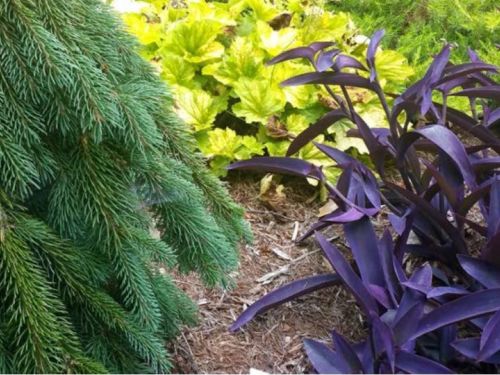
The Harrison Tuttle conifer garden in Raleigh reveal contrasting colors and textures, all working together to create a patchwork harmony
Gardening with Conifer Colors in Mind
Contrast is a way to increase interest in a planting arrangement; be it a pot, a small bed, or a rolling landscape. Contrast necessitates choosing a variety of plants for color, height, texture, and shape; all of which conifers can provide.
Using color contrast is a solid way to gain attention in your conifer gardening. For example, an Abies nordmanniana ‘Golden Spreader’ (golden spreader Nordmann fir) and a Picea pungens ‘Montgomery’ (Montgomery Colorado blue spruce) planted together demand attention and provide impact, which are not delivered by repetitious planting in typical landscapes.
A design might contain an entire bed of contrasting purple foliage, such as Tradescantia pallida (purple-heart), dotted with lemon-yellow conifers, like Chamaecyparis obtusa ‘Fernspray Gold’ (golden fernspray Hinoki cypress).
However, when arranging plants for color, a better approach would be to relegate a few areas for the installation of contrasting elements. The areas in between can then be used as vehicles to guide the eye smoothly from one place to another. Related colors of varying intensities tie the areas together, while keeping in mind the adage that less is more.
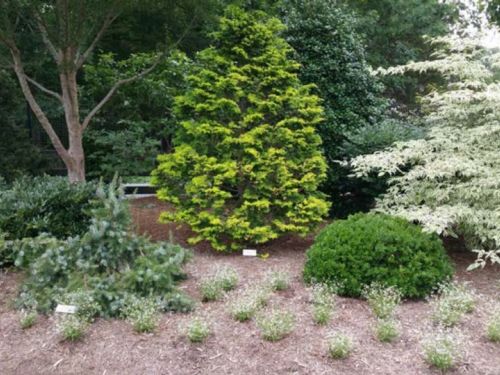
Conifers of varying heights, along with perennials in North Carolina's Unique Garden in Chapel Hill demonstrate a good mix of texture and color in its gardening
Conifers: Small and Tall
Differing heights are another way to liven up your planting bed. Consider height and proportion in choosing conifers. Tall conifers lined up in a row, like soldiers at attention, appear rigid and regulated. If the goal is to guide the eye from a taller to a smaller specimen, choose a selection of conifers which sweep down to a ground cover. The conifers offer a wide, horizontal structure.
Transitions are integral to the overall composition, also. They can be harsh, as in pairing Cupressus sempervirens ‘Totem’ (totem Italian cypress) with Juniperus horizontalis ‘Bar Harbor’ (Bar Harbor creeping juniper), from tall and thin, immediately reduced to wide and flat.
That same ‘Bar Harbor’ can also sweep up to a Pinus mugo (mugo pine), the branches of which lead the eye upward to an emerging Chamaecyparis obtusa ‘Mariesii’ (Maries' Hinoki cypress). Experience with plants allows the gardener to be better able to demonstrate skill in creating a more relaxing composition.
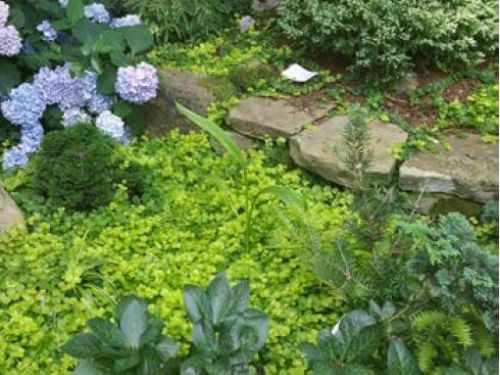
Ground cover, as in the Tuttle Garden in Raleigh, provides a range of color, texture, and height for conifer gardening
Titillate with Conifer Texture
Textures in the garden can also highlightwinter interest. For example, the variety of shades of green aremany. With little other than conifers to view, the characteristics of each plant can pop, even in a variegated, green palette.
Other colors add depth to the overall picture. Sunlight will vary on gold-tipped cultivars, even if in the shade. A bit of white on freshly-emerging stems reveals new growth. As temperatures begin to rise, conifers bring the finest displays of color. Tips burst onto the scene with soft yellows, apple-greens and chartreuse, which, in turn, add finely-detailed color and texture to the design, not to speak of the varied hues of the female cones.
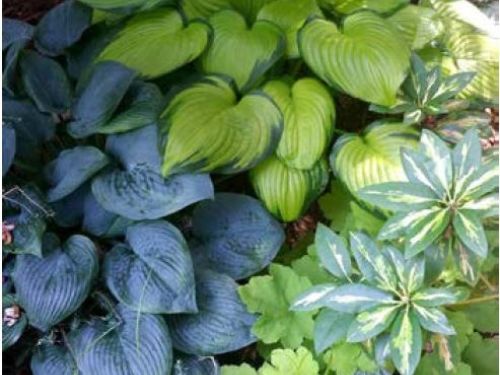
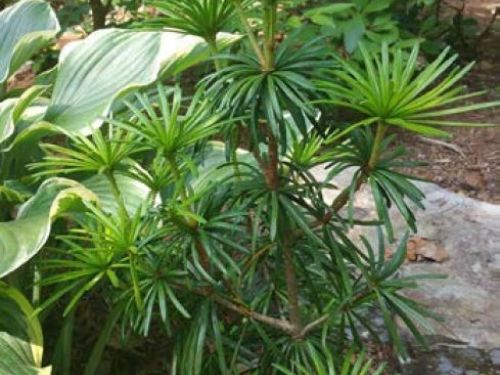
Sciadopitys verticillata (Japanese umbrella pine), a unique conifer at the Tuttle garden
Looking at the Bigger (Garden) Picture
Each genus of conifer has a different, overall look. Cryptomeria japonica 'Spiralis' (spiral Japanese cedar) has branches which form twisted ropes of ringlet-like foliage, whereas Picea omorika (Serbian spruce) stands straight and tall, with lower branches, which weep with age.
Picea pungens ‘Glauca’ (Colorado blue spruce) has a horizontal structure, which speaks of strength. Chamaecyparis obtusa (Hinoki cypress) shows off swirling, fan-shaped leaves, which, from afar, imply movement. Sciadopitys verticillata (Japanese umbrella pine) opens upward and outward, inviting the eye to follow.
Every conifer has a variety of textures and subtleties, even within a single genus. Simply look at a list of C. obtusa (Hinoki cypress) specimens alone and appreciate the wealth of plants to investigate!
A play with gardening colors and texture in The Harrison Tuttle garden in Raleigh
The overall form of conifers is worthy of consideration, as well. Think about contrasting colors, texture, and height. Tall conifers can be skinny, plump, or airy. Short, rounded, shrub-shaped specimens can be open and lacy, or solid and thick. Does the specimen weep, curve upright, or maintain the same shape, simply growing wider and taller?
Although it is better to situate conifers in the right place from the start, they can be moved about easily, as the garden expands. When it comes to designing a garden, nothing is written in stone!
As I look back at the gathering of last summer in Raleigh, I appreciate that Tony Avent provided examples to ACS attendees to consider when designing a landscape, no matter how large or small that landscape is. May the thoughts and photos I have presented be further inspirations for use of contrast in landscape design.
Text and photographs by Mary Warren.
Mary Warren lives in Seattle with her husband, Dan Gurney. They are co-owners of Gardening Artist. Mary also serves as head gardener at Bramble Bump-JM Cellars Winery in Woodinville, Washington.
This post has not been tagged.
Permalink
|
|
|
Posted By Admin,
Wednesday, June 7, 2023
|
By Tom Cox
November 13, 2019
Discover the memorable conifers of Melbourne, Sydney, and Hobart.
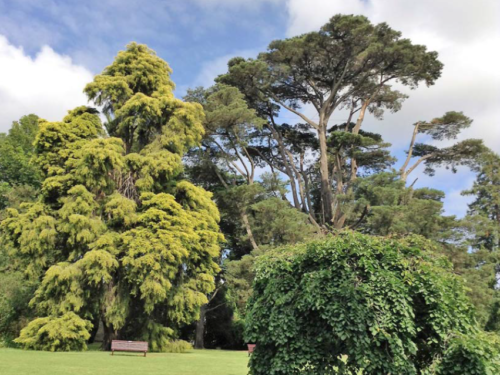
The conifer, Bhutan cypress (Cupressus torulosa) behind the bench at Royal Botanical Gardens, Melbourne
Evelyn has always been keen to attend the Australian Open Tennis Grand Slam in Melbourne, Australia, and I have wanted to visit some of the gardens in and around Melbourne, Sydney, and Hobart, Tasmania.
This would require some delicate balancing of competing interests. For starters, I am a member of the International Dendrology Society, and one of the Australian members put me in touch with a fine gentleman named Alistair Watt. Alistair is noted as having the best conifer collection in Australia. After a brief introductory email exchange, we were invited to spend our first night in the country with him and his wife Julie.
After our arrival in Melbourne, we picked up a car and headed south on the Great Ocean Road to a small town where they live, named Lavers Hill. The scenic drive along the coast through the picturesque towns of Lorne and Apollo Bay took over 4 hours. This drive was highly recommended by fellow ACS members Joe and Jan Hallal, and did not disappoint. Along the way, we would spot our first Koala bears and several colorful bird species.
Landing in Lavers Hill
Upon our arrival, both Julie and Alistair warmly greeted us in their driveway. Any concerns about intruding were quickly vanquished. These were down-to-earth people who appeared genuinely happy we were visiting them. All around us were conifers from the four corners, and most were mature; suggesting Alistair had been at it for a number of years.
Outside of Bedgebury, their garden represented one of the best conifer species collections I had ever seen. While many were familiar, there were some from areas such as New Caledonia and Fiji which had never crossed my path, except as conservatory plants in places such as Edinburgh, Scotland, and Atlanta Botanical Garden. I am guessing he was Zone 8b and in some pockets Zone 9.
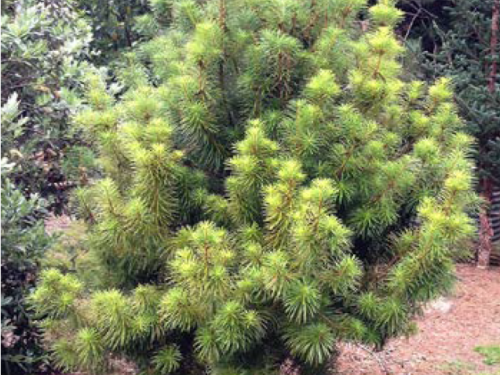
The conifer, Cathay silver fir (Cathaya argyrophylla)
Meeting the President (of the Australian Conifer Society)
Alistair related that most all the material in his collection was wild, collected with a specific focus on species from the Southern Hemisphere; having made many collecting expeditions to New Caledonia, Chile, and Fiji. He also cultivates a large number of non-coniferous genera including rhododendrons from China. I was particularly impressed that he was the founding President of the Australian Conifer Society and served in that capacity for many years.
He has freely shared material with other botanical institutions within Australia. Significant in his plantings were large specimens of Araucaria laubenfelsii, A. montana, and Agathis ovata, as well as a large collection of Mexican pines such as Pinus patula. On the very rare side, were conifers such as Dacrydium guillauminnii, Acmopyle sahniana, and Neocallitropsis pancheri. For me this was rarefied air, and I felt fortunate to be in the midst of a conifer giant in a one-on-one environment.
All too soon the sun disappeared, and we were being summoned to an Australian family home cooked dinner. This was so much nicer than eating in a restaurant. Conversation ran the gamut from plant collecting, to history of Australia and everything in between. It became obvious that Alistair and Julie were well read.
A Farewell to Victoria
The next morning, after a delicious breakfast, the Watts drove us to a rain forest where we were surrounded by huge ferns and other angiosperms. It was here we encountered our first glimpse of wallaby which remotely resemble kangaroos. Mid-morning we returned to their home for a quick good-bye to this splendid place. They invited us to extend for two more nights, but holding to the commitment I promised for balance, we regrettably headed for Melbourne.
On a final note, Alistair is writing a book on the great plant explorer Robert Fortune, for which I hope to offer a review. For those interested in further world exploration, here is an excerpt from my most recent e-mail from him regarding travel in China.
The highlight at the end of our trip was a visit to the fabulous Tianmushan to the southwest of Shanghai. Here at 1,100 meters there are huge Ginkgo growing wild in a superb forest also with gigantic 1,000-year old Cryptomeria with Torreya, Emmenopterys henryi, Liriodendron chinensis, and evergreen oaks.
However, I must confess that the best for me was seeing the wild Pseudolarix amabilis at 45meters in height. The best bit is that we did not have to walk up to 1,100 meters – there is a tourist road and tourist shuttle buses up to that altitude, made of slab paths through the forest! However, we did decline to hire the mountain sedan chairs.
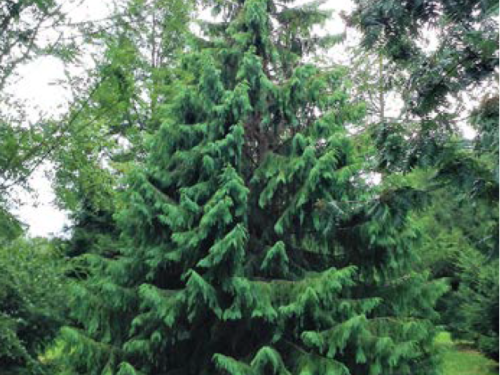
The Chinese coffin tree (Taiwania cryptomerioides)
Touring the Royal Botanic Gardens, Melbourne
Our next stop was Melbourne, where we spent four exciting days. Significant among the activities was attending the 2015 Australian Open Grand Slam tennis event. This is a well-organized venue, and transportation to and from the stadium was easy via a train near our hotel.
No visit to Melbourne would be complete without a visit to the Royal Botanic Gardens (RBG). Upon our arrival, we were met by Ms. Jenny Happell, who works as a guide, and Dr. Roger Spencer, Senior Horticultural Botanist, who happily had arranged for a motorized cart. The grounds are vast, and the cart afforded the opportunity to see the entire property.
Knowing that we had a special interest in conifers, great care was given to make sure we saw the extant specimens. This is a species garden with the largest examples of Keteleeria fortunei (China), Cupressus torulosa (India, Bhutan and China) and Pinus patula (Mexico) I had ever encountered.
These were trees, the size of which one only reads about in plant books. The garden offers the visitor an opportunity to see a number of rare conifers as well as flowering trees and shrubs. Like all gardens we visited, RBG Melbourne is well maintained, the plants are well labeled, and the setting is stunning.
Heading Sydney-Side
After a brief plane ride, our next stop was the beautiful city of Sydney. I tend not to be too excited these days by large cities, but Sydney was an exception–great restaurants, hotels, friendly people, and always a sense of feeling safe.
Upon arrival, we were met at our hotel by Stuart Read (also a member of the International Dendrology Society), who is in charge of city planning for Sydney. This turned out to be a most fortunate contact, as Stuart approves all tree selections and planting as well as all architectural designs. As such, he has a unique view of all things horticultural.
After arranging a harbor tour on one of the ferries, we took a casual stroll through beautiful tree-lined neighborhoods where he pointed out significant trees and buildings. Later we went to dinner in some obscure back alley with hundreds of decorative birdcages strung across the street–which one would only find were one in the know. At the conclusion of dinner, Stuart presented me with a handwritten list of conifers we should see the next day during our visit to RBG Sydney.
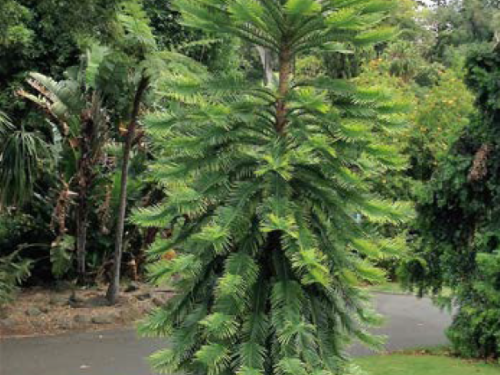
The conifer, wollemi pine (Wollemia nobilis) at the Royal Botanical Gardens, Melbourne
A Conifer Garden in the Heart of the City
It is funny how, if you’ve been at something for a long time, people re-appear in the most unusual settings. Way back in the late 1990’s I visited the Dallas arboretum and established a relationship with their senior director, Jimmy Turner.
Jimmy is now the Director of Horticulture at RBG Sydney. The Royal Botanic Gardens is a major botanical garden located right in the heart of Sydney. Opened in 1816, the garden is the oldest scientific institution in Australia and one of the most important historic, botanical institutions in the world. Its stunning position is on Sydney Harbor, overlooking the Sydney Opera House and a vast expanse of large public parklands.
While Evelyn toured the Sydney Opera House, I was escorted around the gardens; taking great care to see their magnificent collection of conifers. This was the equivalent of a hop-on/hop-off tourist bus, except better. Like the other Royal Botanic Gardens of Australia, this is a species collection which is comprised of conifers from around the globe. Of particular note was a well-formed specimen of Glyptostrobus pensilis, which is native to subtropical southeastern China and northern Vietnam.
Conifers on the (Bondi) Beach
The species is listed as critically endangered and is nearly extinct in the wild due to overcutting for its valuable decay-resistant, scented wood. Most specimens I have observed (even in China) tend to be rangy and not particularly garden-worthy. The lone exception are trees growing at the Lovett Pinetum in Angelina, Texas, which was started by ACS member, Dr. Bob Lovett.
As an aside, if you ever find yourself in east Texas, this is well worth a visit. We also grow several specimens here at the Cox Arboretum, to include one which is getting on nicely after a bear climbed it and broke off the top 6’. Many of the extant conifers at RBG Sydney are clustered in an area very near the café where Evelyn and I enjoyed coffee with several of the arboretum’s staff. It was then on for my tour with their top conifer expert, Peter Sweedman. As he whisked me from plant to plant in a motorized cart, it was–Conifer overload!!!
We spent a total of 4 days in Sydney and, thanks to a great transportation system to include the hop-on/hop-off sightseeing bus, we covered much of this leafy city. It was a thrill to visit the famous surfing area on Bondi Beach, which was heavily planted with Araucaria columnaris (Cook pine) and A. heterophylla (Norfolk Island pine).
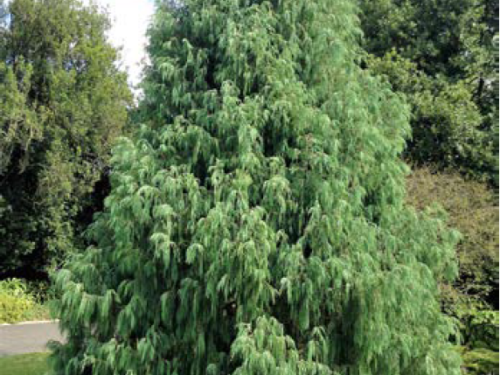
The conifer, Kashmir cypress (Cupressus cashmeriana)
Tuesdays in Tasmania
Our final stop in Australia was on the island of Tasmania and the capital, Hobart. Regrettably, we only scheduled 3 days here, which was not nearly enough time to explore. As was the case in previous cities, the highlight was our day at the Royal Tasmania Botanical Gardens. While this is the second oldest garden in Australia, it seemed much older than Sydney. As I reflect back, Sydney had more modern structures where this garden oozed with old-world charm.
For starters, there are the Historic Walls, which were constructed in 1829 as a measure to shelter more frost tender plants. Constructed by convicts, the walls provide structure and unique heritage value to the Gardens. Other significant structures include the Anniversary Arch built in 1913, and the cast iron entrance gates constructed in 1878.
The garden is widely known for its collection of conifers that was started around 1859, with certain conifers arriving almost at the same time as they were introduced into England (for example Sequoiadendron giganteum). It was a special moment to see ancients such as Wollemi pines (Wollemi nobilis) flourishing alongside Metasequoia.
A Stunning View at Journey's End
If you travel to Hobart, be sure and allot time for a drive up to the top of Mount Wellington for a spectacular view of the city. Rising 4,163 feet, there is a narrow road (Pinnacle Road) you take to the summit. The day we went, the weather was cool and windy, and we were the only visitors. The flora and terrain were quite varied as we made our way to the top.
At some point, we climbed past the tree line and into a dense fog, punctuated by a rocky, tundra-like landscape. Reminding us of nothing, this place is definitely unique and worth the time. On the way back, we stopped at the Cascade Brewery which was established in 1832, and is the oldest continually operating brewery in Australia.
Photographs by Tom Cox.
Tom Cox is past president of the American Conifer Society and the founder and owner of Cox Arboretum and Gardens in Canton, Georgia, where he focuses on evaluating, selecting, and displaying plants from around the world that are hardy in USDA Zone 7b. He is also concerned with preserving critically-endangered plants.
This post has not been tagged.
Permalink
|
|
|
Posted By Administration,
Wednesday, June 7, 2023
|
By Susan Eyre
February 1, 2020
Evergreens and Conifers for Shade
Make the best of sheltered spots in your garden with our list of shade-loving conifers.
Conifers made for full, deep, dark shade: 3 hours or less of sun
- Taxus x media
- ‘Viridis’: narrow dwarf form
- ‘Stovepipe’: seedling of Hick’s yew

The conifer, Canadian Hemlock (Tsuga canadensis 'Albo-spica')
- Tsuga caroliniana
- ‘Mountain Mist Sister’: superb weeping hemlock, longer needles
- Tsuga diversifolia
- Dark green foliage, known as the rice hemlock from Northern Japan. Grows wide as tall and does not burn in sun
- Evergreen broadleafs
- Buxus ‘Green Mound’
- Rhododendrons and Azaleas
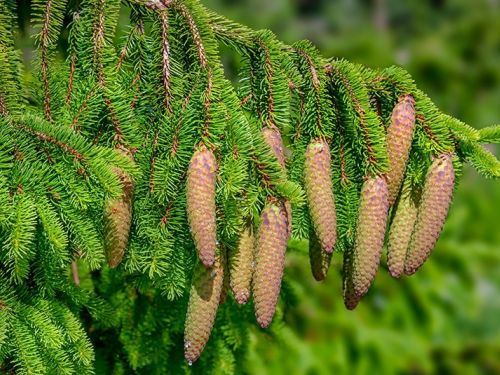
The conifer, Norway Spruce (Picea abies 'Acrocona')
Conifers made for partial shade: 4–6 hours of sun
- Picea abies
- ‘Acrocona’: irregular weeping form with purple pink cones on branch tips in spring
- ‘Pusch’: witch’s broom of Acrocona, tiny pink cones in spring
- ‘Clanbrassiliana Stricta’: superior pyramid for the landscape
- ‘Cobra’: bizarre tree with rat-tail branches; forms a skirt
- ‘Elegans’: low flat, nesting spruce with early bud break
- ‘Hillside Upright’: irregular form, dark green congested needles
- ‘Weeping Blue’: upright grower with pendulous branches
- Pinus strobus
- ‘Blue Shag’: soft, blue-green needles, with slow mounding habit
- ‘Fastigiata’: narrow upright form that becomes large
- ‘Hershey’: dwarf form from witch’s broom at the Hershey Estate, PA
- ‘Horsford’: slow-growing globe, mounding habit on standard
- ‘Niagara Falls’: dense habit with pendulous cascading branches

The conifer, Dwarf Eastern Arborvitae (Thuja occidentalis 'Linesville')
Conifers made for morning sun (area that gets cool morning sun and is shaded in afternoon from hottest sun)
- Abies koreana
- ‘Aurea’: spectacular golden pyramid
- ‘Green Carpet’: prostrate form with purple cones in spring
- Picea glauca
- ‘Conica’: dense conical, dwarf Alberta spruce
- ‘Jeans Dilly’: superior dwarf form of Alberta spruce

The conifer, Dwarf Alberta Spruce (Picea glauca 'Conica')
- Picea orientalis
- ‘Connecticut Turnpike’: irregular windswept habit
- ‘Fat Boy’: dwarf pyramidal form, dark green foliage
- Pinus cembra
- ‘Glauca Nana’: great blue-green with a slower growth rate
- ‘Pygmaea’: dwarf compact form with great blue color
- ‘Stricta’: columnar form with fastigiated branches
- Pinus parviflora
- ‘Bergman’: unique Japanese white pine with twisted needles
- ‘Fukuzumi’: compact, wide spreader

The conifer, Japanese White Pine (Pinus parviflora 'Bergman')
Japanese Maples & deciduous trees and shrubs
- Acer griseum
- Paperbark maple, cinnamon exfoliating bark, red fall color
- Acer palmatum
- ‘Red Emperor’: dark red foliage all summer
- ‘Twombley’s Red Sentinel’: narrow form, great color, bright red in fall
- Acer palmatum var. dissectum
- ‘Seiryu’: green leaves, reddish tips in spring, crimson in fall
- Acer japonicum
- ‘Aconitifolium’: green in summer, yellow-orange-red in fall
- Acer shirsawanum
- ‘Aureum’: full moon maple, yellow palm-shaped leaves, orange-red in fall
- Aesculus parviflora
- Bottlebrush buckeye with white flowers in mid-summer
- Cercidiphylum japonicum
- ‘Pendula’: Graceful pendulous branches, dramatic specimen
- Fagus sylvatica
- ‘Purpurea Tricolor’: fabulous European beech, a must-have in your garden
- Ginkgo biloba
- ‘Mariken’: slow-growing compact round form of Ginkgo
- Hamamelis x intermedia
- ‘Firecracker’: a witchhazel which blooms reddish-orange in early spring
Perennials for shade
Hosta, Astilbe, bleeding heart, perennial geranium, fern, Pulmonaria, Hakonechloa grass, Heuchera.
Planting in the understory of existing trees: Roots of existing trees will compete for water, so you must remember to water frequently for more than the first year. Trying to get established in existing root masses can take longer.
Check growth rates and hardiness zones of trees on our website at Rich's Foxwillow Pines Nursery. Sign up for our newsletter and ‘Like’ us on Facebook.
This article was originally published in the Spring 2016 issue of Conifer Quarterly.
This post has not been tagged.
Permalink
|
|
|
Posted By Admin,
Wednesday, June 7, 2023
|
By Edward Weiss
February 29, 2020
Redesigning your conifer garden? Be inspired by a modernist architecture and industrial design, “Form follows function.”
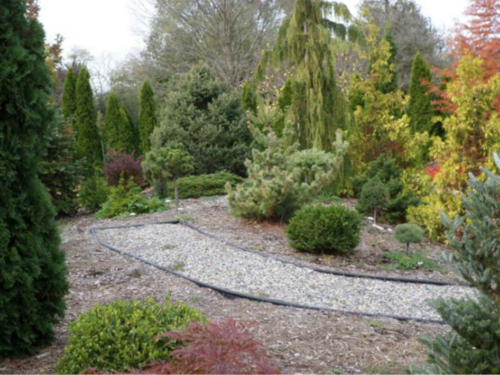
A view of the conifer garden's top of berm, in the West end
“Form follows function” is a principle associated with 20th century modernist architecture and industrial design, which says that the shape of a building or object should primarily relate to its intended function or purpose.
The term easily fits for designing a conifer garden, or any garden for that matter. You need only ask yourself what you want to accomplish before starting your project.
Before we begin on how our garden came together, a few background notes are in order. It has been approximately seven years since we started this project. We moved to Ann Arbor from Detroit, bought a house, gutted it and put it back together; an almost two year effort which allowed landscaping ideas to present themselves.
Our lot is a non-uniform shaped, subdivision plot on a cul-de-sac. The lot size is a little less than 14,000 square feet with a 4-6 foot high berm along the 130-foot length of the property.
Take away footage for the house, garage, driveway, patio and potting shed, and there isn’t a lot of land left for a conifer collection, yet we soldiered on. To date, we have over 100 different varieties of conifers for a total of approximately 150 trees and brooms.
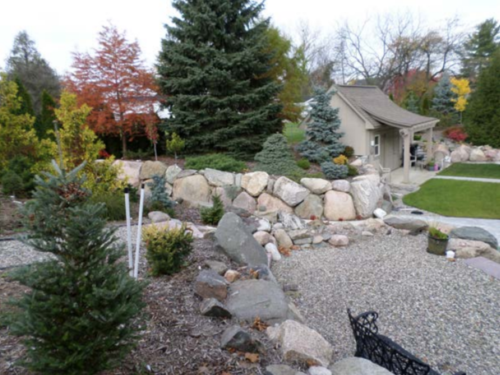
The view to potting shed from top of berm of the conifer garden
Some of the principal design functions were:
1. Provide a screen to road activity along the 130-foot south side length of the house, where the berm is located. In addition, on the north side of property, our goal was to develop an attractive privacy screen to other neighborhood houses.
2. Install a closed loop geothermal system.
3. Allow access to the city bus stop without having to climb over the berm.
Modest wishes!!
How and what was accomplished:
1. It didn’t take much thought to decide that conifers were the best choice for screening road activity, especially in the winter when deciduous have lost their leaves. We used the same concept for establishing a pleasing privacy screen from other houses in the subdivision.
With that basic function defined, one would think it would be a simple task to go ahead and plant. Unfortunately, to a novice, it opened a vast array of options as to which conifers to select and purchase...thus began the journey.
2. The geothermal heating/cooling system was a straightforward process to install. It was necessary to cut back the berm along the entire length of house so that a large drilling rig could be brought in to drill the geothermal vertical lines.
That accomplished, it left us with a dramatic cut along the entire length of the berm. To maintain the effect, it was necessary to do something to retain the dirt. A boulder wall seemed a sensible answer.
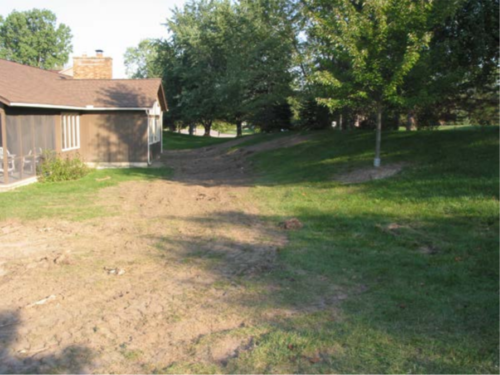
Berm before rock wall installation in the conifer garden
After doing the math, it became apparent that it would take a lot of stone to complete this task. Researching stone sources and cost, we found we could purchase the stone directly from the source instead of going through a middleman and at quite a reasonable cost because we were buying over 200 tons of boulders.
In fact, we were able to go out into the fields where they were excavating the boulders and choose the actual stones we wanted. Over several weeks, as new boulders were dug up, we would go out again and again to select our stone. In choosing the rocks, we didn’t want a wall with stacked round boulders and opted for flat and broken faces.
3. Getting to the city bus system on the other side of the berm without climbing 6 ft. up and down, was accomplished by cutting a 5 ft. wide snaking path through the berm. Both sides of the path were reinforced with more large boulders to hold the two sides of berm in place. The snaking path was also designed to avoid a straight line view into the yard from the street.
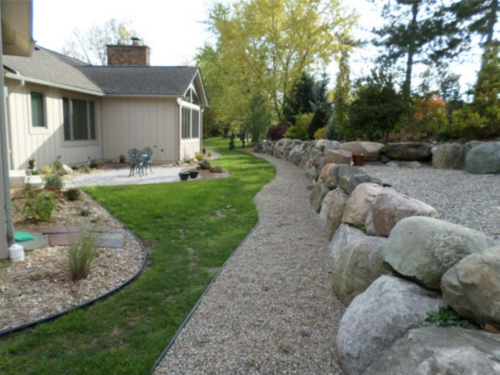
Berm after rock wall installation in the conifer garden
Beginning the design and our process:
1. Look, read, and look some more!! We had to develop some sense of the types of landscape designs that appealed to us. We searched online for garden pictures, borrowed books from the library, and, when we were out driving, keeping our eyes open for landscape ideas, both residential and commercial.
We also visited nurseries and surveyed what was available. We understood that this was not going to be a one season event, so we developed a "don’t panic” attitude.
2. We took photos from different locations inside the house, looking out the widows in order to locate key views. From the photos, we set up markers for planting sites. If we were to ever advise others, it would be to take your time establishing your views because you will be looking out those windows for many years to come. This is doubly important for us in the north who spend so much time during the winter indoors.
3. Selecting trees overview: Our approach to tree selection encompassed very basic concerns: color, texture size and shape.
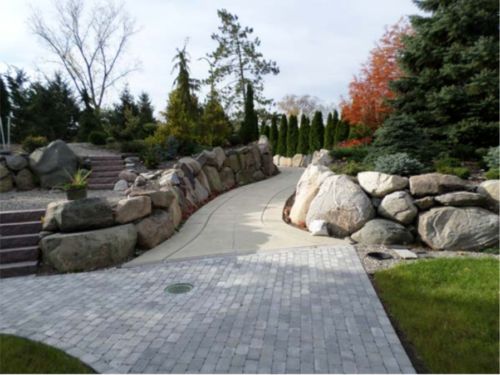
The conifer garden's walkway to the bus stop
Color and texture
To any beginner, collecting conifers is a fascinating discovery that conifers come in a large variety of colors. Once you can get over the presumption that yellow-needled trees aren’t sick or dying, you can begin playing with the many shades of blues, greens, and yellows.
Everybody loves conifer cones, and a unique aspect of some conifer trees are the cone colors which can equal the excitement of any flower in bloom, for example -- Picea abies ‘Acrocona’, Picea abies ‘Pusch’, Abies koreana ‘Cis’, Abies koreana × lasiocarpa.
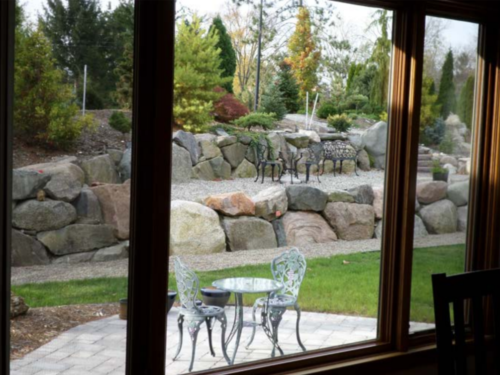
The view of the conifer garden from inside the house
Size and Shape
Because of our limited space we approached the aesthetics of size in three ways. First, we concerned ourselves with the shield/barrier to the road on the back side of the berm. Our choices emphasized, for the most part, full/dense evergreens. Included in this group were: three Cupressus nootkatensis ‘Pendula’ and three Tsuga canadensis, Picea abies, Picea pungens 'Moerheim', and Juniperus chinensis ‘Mountbatten’.
Second, we wanted to continue with tall trees, but cut down on the width. We maximized the tall and narrow with mixed conifers and deciduous trees: Cupressus nootkatensis 'Green Arrow', Thuja occidentalis 'DeGroot's Spire', Juniperis communis 'Lemon Spire', Liquidambar styraciflua ‘Slender Silhouette’, Acer saccharum 'Newton Sentry', and Quercus robur 'Crimson Spire'.
Third, brooms and conifer miniatures worked well for maximum use of ground space. Some of our favorites are: Abies concolor 'Hosta la Vista', Taxodium distichum ‘Gee Wizz’, Pinus Strobus ‘Squiggles’ and ‘Wiggles’, Pinus mugo ‘Mops Top South’ and ‘Mops Top North’, Pinus mugo subsp. rotundata ‘Maja' [SS #26], Picea abies ‘Chub’, Abies cephalonica ‘Meyer's Dwarf‘, Larix kaempferi ‘Nana’.
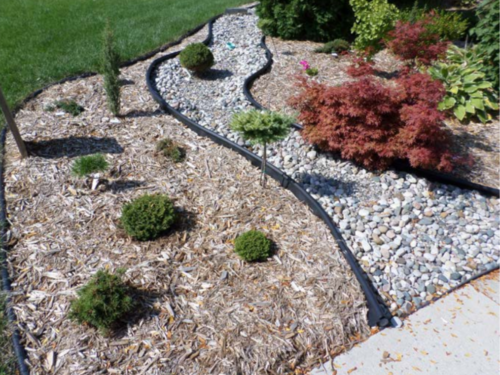
The front of house area of the conifer garden, next to the driveway
Final Thoughts
Once you start collecting different conifers, they all become special, though some do seem a little more special for no particular reason. For us it’s Picea pungens 'Ferrance Skirt', Pinus heldreichii 'Green Bun’ and Picea schrenkiana 'Nana'.
In summary, “Form Follows Function” can be simply viewed as: what do you want your garden to do? Is there a necessity or problem to solve such as water control, privacy, views from windows or an outside patio?
List your wants and issues, do your homework by visiting other gardens, review garden books and talk to experts. Then have fun designing your garden.
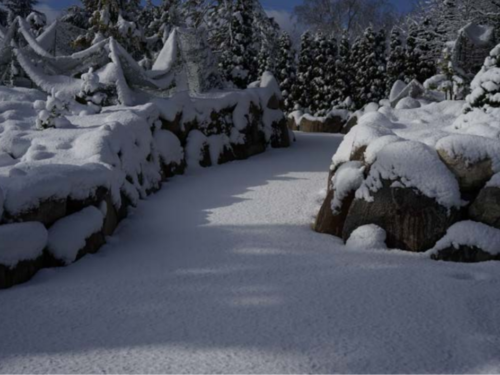
The conifer garden's walkway to bus stop in the winter
Ed & Colleen Weiss’ Garden is open to Conifer members. Check the ACS member directory for contact information.
This post has not been tagged.
Permalink
|
|
|
Posted By Admin,
Wednesday, June 7, 2023
|
Discovering New Conifers in Canada
By Bill Journeay
February 23, 2020
Get to know the Journeay in discovering a new conifer cultivar.

The conifer, ‘Halle’s Cone’ red spruce (Picea rubens ‘Halle’s Cone’)
For many years I have marveled at the extreme variations in our native trees. As I travelled the forest of eastern Canada during my career in the forest industry, I discovered some very strange plant forms. Since retiring, my wife and I have joined the American Conifer Society. We are amazed at the many cultivars previously unknown to us in this area. We also noticed that many of the northern conifers were not as widely publicized.
Several years ago, I decided to start collecting and propagating some unique and yet bizarre plants. I would like to introduce a few of the many selections I have found and named and hope that others might enjoy them as much as we do.
Most of my selections can be found at Kingsbrae Gardens (ACS Member) in St. Andrews, New Brunswick. I strongly recommend a visit to the gardens where they have recently added to their conifer collection. I continue to add new specimens as I find them each year.
‘Halle’s Cone’ Red Spruce
Red spruce (Picea rubens) is quite common in Atlantic Canada and some very interesting dwarfs have been discovered. One that I’d like to share is the very slow growing conical P. rubens ‘Halle’s Cone’that was discovered growing in an industrial plantation in Nova Scotia.
The tree is currently about 5 feet tall with dwarf foliage and cones and is about 30 years old. A very dense conical shape has been retained with annual height growth about 2 to 4 inches per year. This tree has been successfully transplanted into cultivation but is not yet propagated.

The conifer, 'Charlotte's Pillow' red spruce (Picea rubens ‘Charlotte’s Pillow’)
'Charlotte's Pillow' Red Spruce
Another red spruce P. rubens ‘Charlotte’s Pillow’ was also discovered growing in the wild in Nova Scotia and is a dwarf dense mound with typical red spruce foliage and a darker green color. The tree is also about 30 years old and 2 feet tall with very slow annual growth (<2 inches per year). It has not yet produced seed. This tree has also been successfully transplanted into cultivation but is not yet propagated.
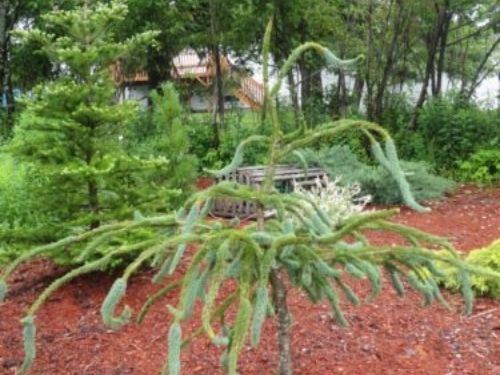
The conifer, 'Scotia Spider' white spruce (Picea glauca ‘Scotia Spider’)
'Scotia Spider' White Spruce
A few years ago I discovered a bizarre white spruce I have named Picea glauca ‘Scotia Spider’ growing in the ditch along a major highway in Nova Scotia. This tree is quite breathtaking in that it has very rapid height growth with little or no internodal branching at any part of the tree and a pronounced hook at the ends of lateral branches. This tree has been successfully propagated by grafting but has not yet produced any cones

The conifer, 'Jack William' black spruce (Picea mariana ‘Jack William')
'Jack William' Black Spruce
Another interesting specimen is Picea mariana ‘Jack William.' This was discovered growing in the wild in a spaced young conifer forest, which is a natural population that has been mechanically thinned to optimize growth for commercial purposes.
It has a very upright habit with very attractive weeping branches. It has good annual height growth (>1 foot per year) and has been successfully grafted. It is now established at several locations.
The conifer, 'Craig' black spruce (Picea mariana ‘Craig’)
'Craig' Black Spruce
Recently I discovered another very exciting black spruce Picea mariana ‘Craig’ growing in a young forest plantation. This extremely dense and perfectly symmetrical compact black spruce is very similar to Picea glauca ‘Laurin’ and Picea abies ‘Ohlendorffii.' This is a beautiful tree for any location. It has been transplanted to cultivation but has not yet been propagated.
A red spruce and white spruce exhibiting the same compact and symmetrical shape have also been discovered and collected. The small conical red spruce and white spruce were discovered at other locations. The white spruce was along a highway and the red spruce was discovered in a wild population in the forest. All three are now established at Kingsbrae gardens in St. Andrews, New Brunswick.
The conifer, 'Sandy's Gold' white spruce (Picea glauca ‘Sandy’s Gold')
'Sandy's Gold' White Spruce
Lastly, I would like to introduce Picea glauca ‘Sandy’s Gold.' One of my wife’s favorites, this beautiful tree was discovered along with a few other wild trees growing in an old farm field. It is a well shaped tree with an amazing yellow flush of new growth that seems to last longer each year as the tree matures. We expect about 4 weeks of brilliant show followed by a gradual fading to green needles with faint white tips.
I have heard of a few other similar white spruce and a black spruce in the area but have not seen them. This tree is very comparable to Picea orientalis ‘Aurea’ and Picea orientalis ’Early Gold.' It grafts well and has been established at several locations.
These are but a few of the many strange conifers that I have identified and hope to have officially recognized. I have many that are still under investigation and have not yet been named or propagated. Most are at least established in my garden. If there are any readers with a particular interest in all northern conifers, I look forward to hearing from them to exchange ideas and photos.
Bill and Sandra Journeay live and garden in Nova Scotia, Canada.
Editor’s Note: Cultivars are named selections of plants, usually clonally propagated. To formally name a cultivar, the name needs to appear in print. With this article, Mr. Journeay has officially named the plants. The plants not yet propagated will become useful cultivars once they are propagated.
This post has not been tagged.
Permalink
|
|
|
Posted By Admin,
Wednesday, June 7, 2023
|
By Maryann Lewis
December 7, 2019
Learn how to enhance the aesthetic appeal of your conifers through the art and craft of pruning.

The conifer, Pinus monticola ‘Crawford’ (Crawford Western White Pine) before pruning
“Aesthetic Pruning embraces the creative interpretation of small trees and shrubs in the urban context. The living art form combines the artistic skills of the pruner, the essence of a tree, the science of horticulture and the needs of the clients and the surroundings.” — Dennis Makishima
The diverse, often sculptural, attributes of conifers, the myriad of forms, textures and colors, add interest to any garden, and appeal to our sense of the beautiful, our aesthetic sense. In this article I would like to emphasize how the aesthetic appeal of conifers can be enhanced through the art and craft of pruning, specifically, through the principles of aesthetic pruning as developed by Dennis Makishima and promoted by the Aesthetic Pruners Association.
Let’s break down the definition of aesthetic pruning as it relates to conifers, and you can make up your own mind!

The conifer, Pinus monticola 'Crawford' (Crawford Western White Pine) after pruning
“Aesthetic Pruning embraces the creative interpretation of small trees and shrubs in the urban context.”
Gardening is all about creative interpretation,
and the woody plants that reside in gardens are no exception; indeed, they are often a garden’s focal point. Woody plants have the ability to provide a story year-round. The bright yellows and blues of the conifers are stunning with a dark winter
sky as a background. The new growth and cones in the spring, the steady background and structure in the summer and fall are only a few features to get us started. In both dramatic and subtle ways, conifers can express the wind, direct visitors to
the front door, or lead your gaze towards the view of a water feature.
Do not be discouraged by reading “urban context” in the definition. We all know of collections that rival the Manhattan skyline in their density! Any garden where people interact on a personal level and scale matters (both practical and in design) should include aesthetics in the formula for long-lasting stewardship. For more on the importance of aesthetics in our lives, read a collection of essays edited by Ritu Bhatt called Rethinking Aesthetics, The Role of the Body in Design. This collection of essays is from a diverse field of professionals who make the argument “that aesthetic experiences can be nurtured at any moment in everyday life.”

The conifer, Limerick Hinoki False Cypress (Chamaecyparis obtusa ‘Limerick’) before
pruning. The tree is growing into the eave of the house and the pathway. The scale of
this tree needs to be both practical and aesthetic
“The living art form combines the artistic skills of the pruner.”
I can honestly say that each of my clients has a great “eye”; meaning, they
see creativity, look for beauty, proportion, balance, movement and all of the artistic terms, with which we are familiar. (Even if they don’t admit it to themselves!) To achieve those artistic elements successfully, one must develop skill. One must
learn the growth habit of a tree, the reactions to pruning cuts in order to prune with design intent. Among my peers, we refer to this as developing our “craft."
How did I do it? Over many years, I completed all of the pruning classes offered at Merritt College and a 20-week, hands-on pruning class which was then offered by senior members Michael Alliger and Yuki Nara; as well as participating in the many volunteer events organized by the Merritt College Pruning Club, where more experienced pruners mentored the group. The most important aspect of this training was receiving feedback about goals, challenges, and execution. This was just the start of my craft development. For me, it will be a lifelong endeavor, and that is the beauty of it! Take all the classes you can find.
Experiment on your own trees. Get feedback.

The conifer, Limerick Hinoki False Cypress (Chamaecyparis obtusa ‘Limerick’) after
pruning. The tree maintains it form and is open enough to encourage new growth on
the interior for future pruning as well as let sun through for balanced foliage
“The essence of the tree”
Defining the essence of a tree is something conifer lovers do on a regular basis. It is one of the reasons why I think
so many coneheads appreciate aesthetic pruning. The essence of a tree is found among the many characteristics we love in our favorite cultivars, which include movement, age, grace, silhouettes, foliage, cones and bark. Conifers also offer an endless
supply of surprises and reveals.
While the Pinus monticola ‘Crawford’ could be identified by its growth habit, needles, and bark; also, what happens when it grows out of its location, and the context of the garden changes around it? One option would be to tear it out and replace it. This is usually not a problem for conifer lovers who have too many trees in pots waiting to get planted, but another option is to see if the tree has potential character that can be revealed with pruning.
Not all trees have this potential. This one has subtle movement within the trunk. Nothing too dramatic, but then, for the location, it doesn’t need to be. It will take a few years to work with the tree’s natural growth habit to develop the branches, and get the proportion of the trunk and scaffold branches right with a balanced amount of foliage. The trunk is not fabulous, but with a little bit hidden and a little bit revealed, our imagination can take over and improve the trunk beyond its original potential. A living, growing tree is always changing. An aspect of the art and craft of aesthetic pruning which I particularly love is balancing the beauty that can be achieved in the present while imagining and planning for the possibilities of the future.

The conifer, Hakuho Japanese black pine (Pinus thunbergii forma corticosa ‘Hakuho’)
bud production after de-candling
“The science and horticulture”
Understanding a tree’s horticultural needs is paramount to aesthetic pruning. Understanding how a tree will respond to your pruning is critical to maintaining the health of a tree and to maintaining the integrity of the tree’s design. Horticultural knowledge is essential and available through university extension programs, college courses, books and the Internet. In addition to learning from horticultural experts, aesthetic pruners are constantly using personal observations to assess growth, development and environmental conditions in the garden.
The example at right compares the bud growth from a Pinus thunbergii forma corticosa ‘Hakuho’ and a Pinus thunbergii ‘Thunderhead’. The ‘Thunderhead’ has grown in popularity in Japanese-style gardens because it is vigorous and can handle conditions that would stress a species tree or other cultivars. It produces a thicker and more brittle branch and a copious amount of buds when candled. ‘Thunderhead’ responds well to autumn thinning cuts in order to keep its size under control while making room for next year’s beautiful, fuzzy candles and long dark green needles.
Coneheads, hone your observations skills; trust what you see and what you know about your region and climate. Pruning tips you read may need to be adjusted to your region and cultivar, even if you are talking about the same tree.

The conifer, Thunderhead Japanese black pine (Pinus thunbergii ‘Thunderhead’) bud
production after candling
“The needs of the clients and [the] surroundings”
If you do not work in the field
of pruning, you are your own client, and your garden, property and neighborhood constitute the local surroundings, within which your pruning takes place. Many questions can arise such as: do you have need for space, does your garden design require
specific pruning, did you purchase a tree full of character, and, now that it is planted, is growing out of scale and losing its character, is it cascading to the left, but south is in the opposite direction, should you embrace asymmetry when the
perennials have shaded out the bottom corner of your conical Picea.
Look thoughtfully at your surroundings and garden context. Learn to assess your garden, and your pruning will be balanced and unified. Even if you consider your plants
a collection rather than a garden, your trees relate to each other, they relate to sun, wind, viewpoints and scale. If your tree is a focal point in the garden, it relates to the context around it.
Aesthetic pruning as outlined above is
a technique with universal application. Unlike very specialized topiary or Niwaki pruning, its principals apply to any woody plant, in any horticultural setting and garden style. I was recently reminded by Michael Alliger in a keynote speech he gave
at the APA’s 2016 pruning intensive workshop in Oakland CA, that fine art such as bonsai and Japanese garden design have been around for centuries, and that aesthetic pruning is in its infancy. The direction and development of Aesthetic Pruning as
an art and craft is evolving and has an exciting future. I think conifers will lead the way!
Useful references
Books: An Illustrated Guide to Pruning, 3rd Edition, by Edward F. Gilman, and Rethinking Aesthetics: The Role of the Body in Design,
Edited by Ritu Bhatt.
Video: www.Gardentribe.com “Pruning Japanese Maples” with Michael Alliger. (This may be about maples but the aesthetic pruning principles apply to any woody plant.)
Websites: maryannlewis.com, aestheticprunersassociation.org,
aestheticpruning.org, crataegus.com/blog/, bonsaitonight.com/bonsai-blog/
Photographs by Maryann Lewis.
Maryann Lewis is a registered architect and APA certified aesthetic pruner. She co-founded the Aesthetic Pruners Association in 2010, gives presentations and workshops on aesthetic pruning and owns an aesthetic pruning business in Portland, Oregon. She can be reached at [email protected].
This post has not been tagged.
Permalink
|
|
|
Posted By Admin,
Wednesday, June 7, 2023
|
What is a Japanese Cedar?
By Jody Karlin
March 7, 2020
Learn about the diverse shapes and colors of a fan-favorite conifer, the Japanese cedar.

The conifer, 'Rasen' Japanese cedar (Cryptomeria japonica 'Rasen') and its twisted needles
When you love and appreciate the beauty of something, it is human nature to want to nurture it, collect it, and own it. I have to admit, taking on the task of building a garden in the deep South using mostly conifers has been a somewhat challenging experience.
Couple the desire to acquire and collect all you can with the arrogance to believe that you can keep it alive where others have failed, and it enables one to build one heck of a collection, at least for a while.
“Kill and Learn” is my motto after trying to maintain the various genera and species in the heat of the South, and I have an upscale BMW in dead plants on my resumé to prove it.

The cristate Japanese cedar (Cryptomeria japonica 'Cristata')
Cryptomeria: A Diverse Genus
One monotypic genus that truly inspires my collecting addiction is Cryptomeria japonica. Provide raised beds for good drainage and enough moisture, and most Japanese cedars will do great here.
What I like most about Cryptomeria is the varied and mutated cultivars. I call it the “Chernobyl” of genera. The diversity of cultivars, which range from very large to very small, with unique foliage and winter changes in color, testify to the diversity of this genus.
The twisted needles of ‘Rasen’, the fasciations and cockscombs of ‘Cristata’, and the wiry, long branches of  , which I call the “Medusa Crypt”, are only a few of the cultivars I could list that exhibit highly unusual foliage. , which I call the “Medusa Crypt”, are only a few of the cultivars I could list that exhibit highly unusual foliage.

The snake-branched Japanese cedar (Cryptomeria japonica 'Araucarioides')
Large, Medium, and Dwarf Japanese Cedars
Many large growing cultivars like ‘Yoshino’, ‘Jindai’ and the yellow tipped ‘Sekkan’ are available for screens, but many more cool dwarfs abound. Medium sized trees, like the 10’ ‘Taisho-tama’, stay nice and compact, as do ‘Yellow Twig’ and ‘Pom Pom’.
And, some grow into “meatballs” – about as high as they are wide - like ‘Globosa Nana’, ‘Elegans Nana’, and ‘Little Diamond’. Then there are true miniatures like ‘Tenzan’. The one pictured here is 20 years old.

A ‘Tenzan’ Japanese cedar (Cryptomeria japonica 'Tenzan')
The Many Colors of Cryptomeria japonica
Many Cryptomeria change colors in the winter, here in the Southeast. For instance, Cryptomeria japonica ‘Knaptonensis’, which has beautiful, white-tipped foliage in spring and summer, bronzes heavily in the winter.
You can always bet your neighbor $20 that it’s not dead...you won’t win twice! Others, like the ‘Birido’ shown to the right, turn purple.
Given proper drainage and enough moisture, Cryptomeria japonica cultivars will give you a very diverse group of plants to utilize in your garden design.

The Japanese cedar of Knapton (Cryptomeria japonica 'Knaptonensis')

The Japanese cedar of Knapton (Cryptomeria japonica 'Knaptonensis') in winter
Photographs by Jody Karlin.
Jody Karlin settled in Atlanta in 1989 after graduate school in NY and started Just Add Water, his custom design aquarium business. He bought his first house and first conifer in 1997 and proceeded to collect anything and everything he could get his hands on. His two acre garden now has 2000 plant cultivars.
This post has not been tagged.
Permalink
|
|

 Blog Home
 All Blogs
 CR Director
 WR Director
 ACS Secretary
 ACS President
 SER Director
 WR President
 CR President
 ACS Treasurer
 RSS
RSS