How to Make a Hypertufa Pot for Conifers
By Michael Larkin
February 7, 2020
Discover how to make your own hypertufa (stone-like) containers for your conifers.

Miniature conifer and succulents in a hypertufa pot. Photo: plantman56.blogspot.com
After
attending my first National ACS conference in Oregon several years ago,
my idea of using single season annuals in containers changed. Container
gardens typically include tall spindly plants surrounded by colorful
annuals, planted in faded plastic containers. As the season comes to an
end, the plants get sadly redirected to the compost bin, one season and
gone.
The
conference tour visited several beautiful display gardens where I saw
hypertufa (stone-like) containers planted with small conifers and alpine
perennials arranged to form miniature landscapes. I realized then that
there was a new group of plants that I could use in my container
gardens. It did not take too long for my Pennsylvania garden to include
many conifer containers of all shapes and sizes.
After
the conference my goal was to create containers just like the ones I
had seen in Oregon. I purchased and made many different containers. I
experimented with different plants, different soil mixes and then I
worked on making my own containers. This is what I found to work best
for me.
What is a Hypertufa Pot?
Hypertufa
allows you to be creative, childlike, and artistic, while making your
own container. Even mistakes can look good. Instructions on how to make
hypertufa containers can be found on the internet and in many garden
magazines. However the most complete source of information was in the
book, Creating and Planting Garden Troughs by Joyce Fingerrut and Rex Murfitt.
There
are many ways to make hypertufa. My formula starts with equal parts of
Portland cement, peat moss, and perlite. Thoroughly mix the cement with
water to form a damp, but not wet mixture. Add liquid cement color to
the wet mix to make the container more decorative.
Apply
the mix, about 1½” thick, to the inside (or outside) of a mold, usually
a large plastic container. After a day, gently remove the slightly
hardened hypertufa from the mold. Wire brush the pot to create a
textured, stone-like finish. Place the container in a plastic bag to
keep it moist, slowly allowing it to cure for a few weeks. As it cures,
the container will become stronger. Once properly cured, these
containers can remain weather resistant for many years.

A hypertufa container waiting for planting. Photo: plantman56.blogspot.com
Making a Planting Mix for a Hypertufa Pot
Building
a house requires a good foundation. Making a good container garden
requires great soil. Whether you are growing conifers in hypertufa
containers or annuals in plastic pots, success begins with creating a
healthy environment for root growth. The growing medium has to provide
roots with sufficient oxygen and also allow gas exchange in the root
zone.
Bagged
potting soil is mostly peat moss and within a short time the peat moss
breaks down and compacts. My conifers need to stay in the containers for
a few years and, therefore, the soil mix needs to remain functional.
While searching the internet for just the right soil mix, I discovered
the Garden Web forum and read about Al’s Gritty Mix, one of two mixes
created by Al Fassezke – or “tapla” as he is known on the forum. His mix
of ingredients not only creates a well drained, highly aerated soil for
containers, but also allows for air to move through the root system and
by-product gasses to escape. The ideal growing environment!
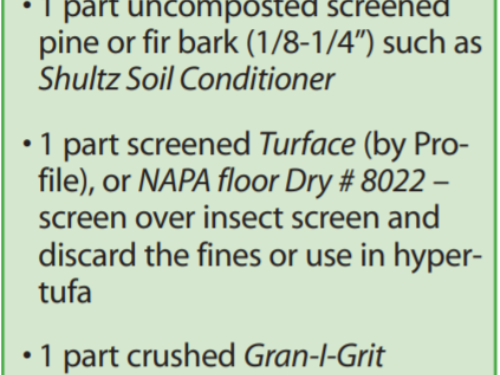
Ingredients for a hypertufa mix
When
you make your own containers you can control the size and number of
drainage holes. My containers have at least one 2” drainage hole which
is then covered with a piece of window screen. We have been taught to
use a layer of gravel on the bottom of the container beneath the soil to
improve container drainage – no longer true.
Instead
of extra water draining immediately into the gravel, the water actually
“perches” or gathers in the soil just above the gravel. This wet area
has no air space, which is not an ideal environment for roots. Roots
grow best in well aerated soil. So the addition of gravel only reduces
the available space for roots to grow. More detailed information on
“perched water table” can be found by doing a search on the internet.
Conifer Selection for a Hypertufa Pot
Unfortunately,
the conifers used in the container will eventually outgrow their space,
and using slower growing plants will keep your planting undisturbed for
a few years. Conifers are classified as mini (grows less than 1” per
yr.), or dwarf (grows 1-6” per yr), which helps when selecting the right
plant for your container.
The
next concern will be to pick a plant that will survive the winter in a
container. Start by using a plant that is at least one zone colder than
your zone. However, additional winter protection may still be needed.
Here are just a few examples of conifers and perennials that I have been
able to grow successfully year round in containers in my USDA Zone 6
garden: Chamaecyparis obtusa ‘Nana’, Zone 5, Juniperus communis ‘Gold Cone’, Zone 4, Picea glauca ‘Jean’s Dilly’, Zone 4.
There are hundreds of alpine perennials, for example, selections of Sedum, Zones 2,3,4 and Thymus, Zone 3, Sempervivum - Zones 3, 4, and occasionally I use non-hardy succulents like Echeveria, Zones 8, 9 – around 150 species – which I bring inside as it begins to get cold.
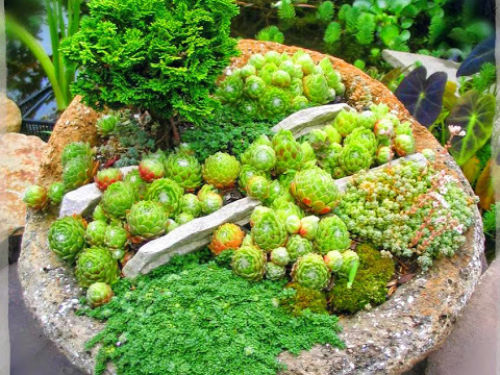
Conifer in a hypertufa pot. Photo: plantman56.blogspot.com
Designing the Landscape of a Hypertufa Pot
A
conifer container can have a design, one conifer in one container, or
you can create a mini landscape. Many nurseries now carry mini and dwarf
conifers in 4” containers, making it easy to plant multiple conifers
and several alpine perennials in one container. Design is a matter of
personal taste. I place a tall accent plant, possibly a small juniper,
off center in the container.
To
create a natural looking scene, place a grouping of rocks inter-planted
with several alpine perennials around the conifer, add a creeping Sedum
or thyme to hang over and soften the edge. Mixing leaf textures will
create visual interest. Once everything is planted cover the soil with a
mulch of fine gravel.
Hypertufa Pot Maintenance and Fertilization
Conifer
containers require a sunny location and minimal care once established.
Newly planted containers will need to be watered a little more
frequently until the roots get established. Since the recommended soil
mix has no nutrients, fertilizer is required. Care should be given not
to overfertilize. More is not better no matter what you grow. Excess
fertilizer in soil makes it more difficult for plants to absorb water
and nutrients. Only give plants what they need.
I
have found good success with a fertilizer that has low NPK (nitrogen,
phosphorus and potassium). I use a very weak solution of liquid
fertilizer on a frequent basis. In nature, plants do better with regular
access to low levels of nutrients, as opposed to sudden large
infusions. I use a fertilizer like Dyna-Gro’s Foliage-Pro 9-3-6, or
similar NPK in a 3:1:2 ratio. It has all the primary macronutrients,
secondary macronutrients (Ca, Mg, S) and all the micronutrients. Its NPK
formula is very close to the ratio most plants actually use. I also
supplement with a little time-release fertilizer in case I forget to
apply the liquid fertilizer.

A larger hypertufa container of conifers, succulents, and low-growing plants. Photo: plantman56.blogspot.com
Conifer Winter Care for Hypertufa Pots
Many
conifer containers can be kept outside all year. However, plant
survival will increase if you provide some extra protection. Roots are
exposed to colder temps in containers than they are if growing in the
ground. As I mentioned above, select plants that are at least one zone
lower than yours.
As
winter approaches, one option is to relocate the container to a
microclimate near the foundation of your house. Avoid the south side
because it might cause the plants to warm and freeze resulting in
heaving. For colder climates dig a shallow hole and sink the container
in the hole. Mulch the container. Another option would be to place the
container in an unheated garage or shed. The plants do not need light
during the dormant period. Bring the pot back out as the temperature
outside begins to warm in the spring.
Container
gardening with conifers is something that anyone can do, even if you
only have a small patio or deck. You are limited only by your
imagination and a sunny location.

 Blog Home
 All Blogs
 WR Director
 WR President
 ACS Treasurer
 CR President
 ACS Secretary
 SER Director
 ACS President
 CR Director
 RSS
RSS