Invasive Conifer Pests: The Siberian Silk Moth
By Gerry Donaldson
March 7, 2020
Get to know a common invasive species in conifers: the Siberian silk moth.
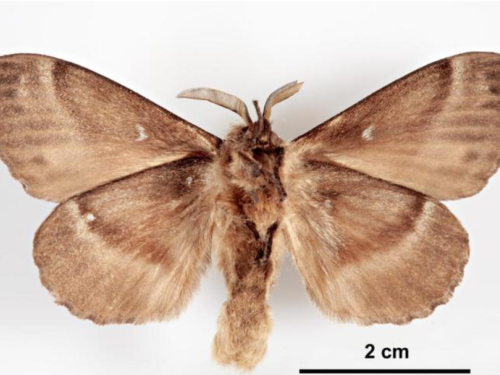
An adult male Siberian silk moth (Dendrolimus sibiricus), an invasive conifer pest
In its native range, the Siberian moth is found in the Urals, Siberia, and other areas of the Russian Far East. The larvae feed on needles and occasionally on the bark of branch tips and cones of most conifers in the Pinaceae family, showing a preference for Abies sibirica, Larix spp., and Picea spp.
Adult moths fly from late June until early August and lay eggs on needles or branches, commonly on branch tips.
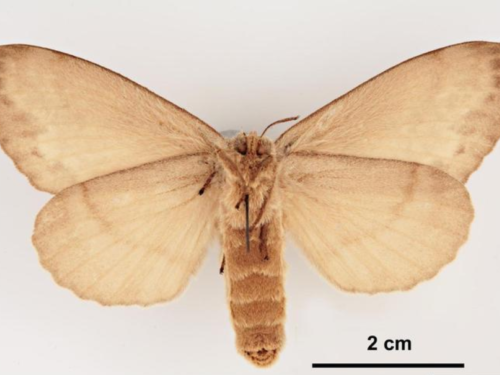
An adult female Siberian silk moth (Dendrolimus sibiricus), an invasive conifer pest
Siberian Silk Moth Population and Outbreak
The population of Siberian silk moth in its native range can remain at levels tolerated by forest trees for many years, but as populations build, rapid outbreaks can occur. Such outbreaks in coniferous forests frequently result in the death of virtually all trees in the infested forest due to a weakening of the trees through defoliation and/or fire.
The length of the life cycle varies from two to four calendar years depending on population density. The larvae of the males have 5 to 9 instars, those of females 6 to 10; typically males have 5 and females 6. The larvae are up to 110 millimeters (four inches) long.
Moths fly from the end of June to the beginning of August and lay eggs on needles and branches. Commonly two winters are spent in the larval stage; second to third instars and fifth to sixth instars overwinter coiled up, under the forest litter. Pupation occurs from mid-June to late July in cocoons in tree crowns.
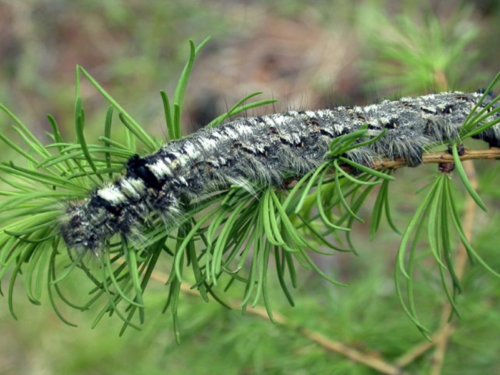
A larvae of the Siberian silk moth (Dendrolimus sibiricus), an invasive conifer pest
Extreme Defoliation and Conifer Death
Because of the variability of the number of instars, those years when a large number of larvae emerge, the result is an overwhelming population and extreme defoliation. The resulting death of a high percentage of forest trees can result in widespread fire.
You can help in monitoring for invasive species by being aware of what is happening in your garden. If you see something that looks suspicious, take a photo and then contact a Sentinel Plant Network member garden, your local extension agent, or your state Department of Agriculture for help in identifying the insect or disease. The USDA provides additional information and educational modules and trainings at https://firstdetector.org/.
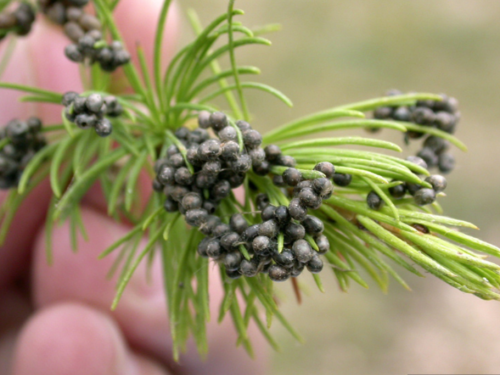
Eggs of the Siberian silk moth (Dendrolimus sibiricus), an invasive conifer pest
Click here to learn how to control conifer pests, or here to read more about other conifer pests like the parasitic wasp, the hemlock woolly adelgid and the Asian longhorned beetle.
Photographs by BugwoodWiki, and the University of Georgia, and the USDA.
This article was originally published in the Summer 2018 issue of Conifer Quarterly.

 Blog Home
 All Blogs
 WR President
 SER President
 SER Director
 ACS Treasurer
 ACS Secretary
 CR Director
 WR Director
 CR President
 ACS President
 RSS
RSS